
The saguaro cactus can live 175 to 200 years, growing just one inch in its first decade. It takes 70 years to grow its first arm. No two are alike. And this park — split into two districts around the city of Tucson, Arizona — is the only place in the world where they grow the way they do. Cam Juarez, Community Engagement and Outreach Coordinator at Saguaro National Park, joins The Parks Podcast to share the full story: the Tohono O’odham people whose entire culture revolves around the saguaro, the ranching and mining history that nearly cost generations of cactus, and how the park has become one of the most community-embedded national parks in the country.
A note from Missy: I loved my time at Saguaro National Park. And in this episode, I learned a lot more about the history and culture associated with it. The park is unique because it’s so close to a city and very accessible — which makes it one of the most welcoming parks in the system.
Episode Guest
Cam Juarez – Community Engagement & Outreach Coordinator /Public Information Officer
Park Stats
- Location: Tucson, Arizona (two districts surrounding the city)
- Park number: 52nd National Park
- Established: National Monument 1933 (President Herbert Hoover); National Park October 14, 1994 (President Bill Clinton)
- Size: 96,000 acres
- Highest elevation: Mica Mountain — 8,666 feet
- Lowest elevation: 2,180 feet (near Sanders Road)
- Annual visitors: 1,010,999 (2023)
- Saguaro count: Estimated 2.1 million saguaros
- Cacti species: 25
- Hiking trails: 165 miles
- Districts: Two — Rincon Mountain District (east) and Tucson Mountain District (west)
- Dark sky: Second darkest sky park in the nation
- Desert type: Sonoran Desert — bimodal desert (summer monsoon rains + winter rains)
- Note: The only place in the world where saguaro cactus grow the way they do
Show Notes & Links
- Plan Your Visit — Saguaro National Park
- West District — Tucson Mountain District
- East District — Rincon Mountain District
- Hiking trails — both districts
- Backcountry camping — Recreation.gov
- Eight-mile paved loop — Cactus Forest Drive (East District)
- Tohono O’odham Nation
- Saguaro fruit harvest — Tohono O’odham tradition
- Cactus Ranger program
- Citizen science at Saguaro
- Arizona-Sonora Desert Museum — near west district
- Dark sky information
Transcript
Saguaro National Park — The Sonoran Desert Redwood
The Parks Podcast, Episode 18 | Cam Juarez, Community Engagement & Outreach Coordinator, Saguaro National Park
What Is a Saguaro?
Missy Rentz: Today we have Cam Juarez, who is the Community Engagement and Outreach Coordinator and Public Information Officer at Saguaro National Park. Cam, welcome to The Parks Podcast.
Cam Juarez: Thank you so much, Missy. I really appreciate you inviting us. I always love to be able to share information with park visitors.
Missy: We start each episode with some park stats. This park is located in Tucson, Arizona. It’s the 52nd National Park, created on October 14th, 1994, when Bill Clinton was president — though in 1933, it was declared a national monument by President Herbert Hoover. The park is 96,000 acres. Its highest elevation is Mica Mountain at 8,666 feet. The lowest elevation is 2,180 feet near Sanders Road. In 2023, there were 1,010,999 visitors. It’s located in the Sonoran Desert. It’s home to 2.1 million saguaros. There are 25 different cacti species in the park. There are 165 miles of hiking trails. The park is made up of two different districts. The oldest rock in the park is 1.7 billion years old. It contains plants and animals from a variety of ecosystems ranging from desert to tropical. And it is the second darkest sky park in the nation.
Cam: Let me break down some of those fun facts. It’s Mica Mountain. And our desert — we’re barely a desert here at the edge. This is the Sonoran Desert, and we are what’s considered a bimodal desert. We get rains in the summer monsoons, but we also get a ton of rain in the wintertime, which allows for our super blooms. So we’re barely defined as a desert because we’re so diverse in the different types of ecologies we have. We start off with desert, go through the tropical, and all the way up to basically a pine forest at the very highest elevation in the park.
Missy: What is a saguaro?
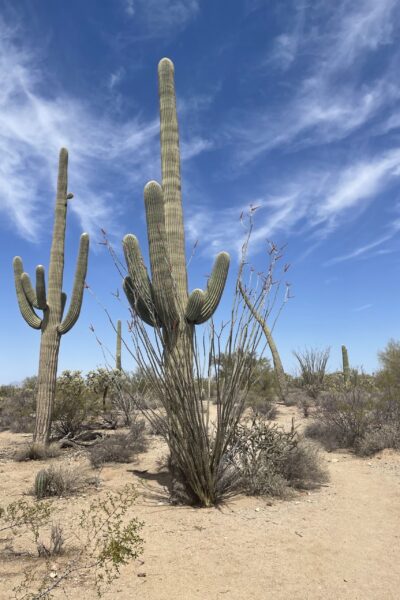
Cam: It’s interesting — even the spelling is interesting because there’s a G in it. In Spanish, we pronounce it saguaro. In English, that G is replaced with a W — saguaro. And the Tohono O’odham, the traditional indigenous people here, call it ha-shan. So a saguaro is a cactus — not necessarily a succulent, a little different — that can grow to be somewhere between 175 and 200 years old. It’s basically the Sonoran Desert redwood. It grows straight up, and the growth always happens at the very top, where you see the white prickly hairs, which are the spines.
Cam: Saguaros — depending where they’re located, whether they’re close to water, whether they get enough sun, whether they had a good nurse plant — every one grows differently. A nurse plant is a tree — a mesquite, a palo verde, anything taller than about eight feet — that protects the saguaro like a mom or dad would protect a child. It protects them long enough for the saguaro to grow, because it’s so slow growing. It will take about 10 years to get to be about an inch high. During that time, they’re super susceptible to all types of elements, including humans — a human can step on a saguaro pretty easily if they’re hiking off trail. Eventually the saguaro will outgrow the nurse plant, and as the nurse plant decays around it, that creates nutrients in the ground for the saguaro to continue to grow. In about 70 years, you’ll see multiple arms — if they decide to grow them. But saguaros are almost like humans. Every one is different. We have crested saguaros. We have saguaros that never grow arms — just one cylinder growing up. And they can grow to be about 65 feet tall. The cool thing is that here in the Sonoran Desert, it’s the only place in the world where it grows the way it does. In northern Mexico, you see some saguaro, but unfortunately they don’t have the kinds of protections we have here in Arizona.
Why Saguaro Became a National Park
Missy: Why was it important for Saguaro National Park to become part of the national park system?
Cam: The former president of the University of Arizona, Dr. Shantz, saw the value in protecting this iconic saguaro. At that point, the saguaro had been in a whole bunch of Westerns and silent movies — it was iconic in the Southwest. But as Dr. Shantz traveled, he realized Arizona was the only place where these cacti grew in exactly the right conditions. Initially, Saguaro National Park started off as a monument. Dr. Shantz used the University of Arizona’s money to purchase this land, which had gone from indigenous peoples to Spanish to Mexican settlers, and then to American settlers after the Gadsden Purchase brought Arizona into westward expansion.
Cam: That land was purchased from the U.S. Forest Service, because the Forest Service didn’t want to manage cactus — they wanted to manage trees. So they had allowed local ranchers to use the area to graze. And that was the main reason we lost as many saguaro generations as we did — cattle were eating the things that would have grown up to protect baby saguaros. We lost generations of saguaros. During the Kennedy administration, the Secretary of the Interior — a local Tucsonan — said, President Kennedy, we need to protect this area. In fact, we probably need to expand to a second district, because we don’t have as many saguaros to protect in the Rincon Mountain District. So they got a second district, honestly, because they kind of screwed up the first one. The science at the time just wasn’t as advanced as it is now. Ultimately, under the Clinton administration, it was raised from a monument to a national park — making us the third national park in Arizona.
The Settlers and the History of the Land
Missy: I’ve read a ton about the history of this land — from the Hohokam to Spanish explorers to ranchers. What was the appeal of that region for settlers?
Cam: A lot of it was westward expansion — you get 40 acres and a mule. This area was predominantly occupied by Apache at that point, so it was about settling the land and, unfortunately, about taking that land from indigenous peoples. Most national parks exist on what indigenous people identify as stolen land — we address that directly because we don’t want to disrespect indigenous peoples. Once that land was occupied by settlers, it was really about resources. There was water at the time. There was an area for cattle grazing — Arizona is still very much considered a cattle state. There was also copper mining. Here in Saguaro National Park, we have over 200 individual mine shafts where people were looking for copper and gold. Our resource management teams have spent thousands of hours filling some of these mine shafts, because rock hounds are still trying to go in and they’re very dangerous — we also lose wildlife in them. So the mine shafts are evidence that this area was coveted for its potential riches. And the climate — you got the summer rains and the winter rains, so it was possible to grow crops as well.
A Surprisingly Diverse Ecosystem
Missy: When I think about Tucson, I think desert and cactus and lizards. But in Saguaro, you have such a diverse ecosystem — including Douglas firs and black bears. How is this park so diverse?
Cam: Tucson is in a very fortunate location. We’re basically in a valley surrounded by the Santa Ritas, the Rincon Mountains, the Catalinas, the Tortolita Mountains — all of these mountain ranges, which we identify here in the Sonoran Desert in Arizona as sky islands, because their elevation goes above the cloud cover a lot of the time. We’re not talking Mount Everest, but in a desert area, to have mountains like that — all of that water is going to land right where Saguaro National Park is. As the earth was maturing, these mountain ranges were pushed out by tectonic activity and volcanoes that created them. So all that water and elevation creates an incredible range of ecosystems within one park.
Planning Your Visit — East vs. West
Missy: When you’re planning a visit to the park, how do you decide whether to visit the east side or the west side?
Cam: It really comes down to what you’re looking for. The East District — the Rincon Mountain District — is a much larger wilderness area. As you go up in elevation, you’re going to find yourself in different ecological areas. If you’re looking for that typical national park experience like Yellowstone or Yosemite, you’re going to be climbing as a backcountry hiker. We have seven different campsites where you can pitch a tent overnight — those require a reservation through recreation.gov. The East District also has an eight-mile loop that was built by the Civilian Conservation Corps. It’s a paved roadway, and a lot of winter visitors or people who are here for a quick visit drive around and stop at different viewpoints. It’s a quick access point to get a feel for the park.
Missy: I did that as kind of my entry — did the loop to get the lay of the land and get comfortable with what I was dealing with.
Cam: Absolutely. Now, the West District — the Tucson Mountain District — I like to refer to it as the Instagram-worthy side because of the saguaros. People have such an affinity for cactus. On the west side, we have a little over 1.8 million saguaros. If you go anywhere on the west side, you’re going to see just an abundance of them. The east side has the remaining of the 2.1 million saguaros we estimate we have — and a lot of new growth. Maybe 50 years from now, we’ll have a lot more saguaros there. But right now, the abundance is on the west. And the west side is also more friendly for mountain biking, with some really nice trails and roadways away from road traffic.
Missy: One of the things I found really challenging was figuring out hiking as an East Coaster used to switchbacks and pine trees. What advice do you have for people preparing for these conditions?
Cam: Our highest visitation is always in the wintertime and early spring or late fall. But in the summertime, we get a lot of folks on road trips who want to check Saguaro National Park off their list — and it’s hot here. If you want to partake in the full experience, wake up with the sunrise and make sure you’re not doing too much during the midday. The hottest time of day here is typically from 11 a.m. to about 4 p.m. Water is going to be a life changer — it’s the most important thing. We do have water stations throughout the area. And the main rule: if you’re halfway down a trail and your water is halfway gone, turn around. I guarantee getting back to your car will be a challenge if you keep going.
Where to Stay and What to Know
Missy: The camping here is all backcountry, but don’t let that deter you — you’re near a city, so there are plenty of other options.
Cam: Absolutely. You can get to either district of Saguaro National Park within 20 minutes from anywhere in town. In the era of Airbnb, you can pretty much rent a house right at the border of our boundaries. There’s grocery stores near both districts. One note — if you don’t have a vehicle, it’s going to be a lot harder to get an Uber to come out and pick you up from inside the park. Consider a local rental car, even just for the day. You can easily hike and have a good experience in both districts in a single day. On the west side, we have Sendero Esperanza and King Canyon Trail — King Canyon is right across the street from the Arizona-Sonora Desert Museum, which is more like a zoo, so it’s a great way to hit both attractions pretty quickly.
Cactus Rangers and Citizen Scientists
Missy: You guys have something very unique called a Cactus Ranger. What is that?
Cam: The Cactus Ranger is a response to living in an urban area. We’re considered an urban park, and we have access to a lot of young people. The continuum of engagement — as I call it — connects with kids as early as three to four months with hiking backpack support, then visits to their schools and field trips for Junior Ranger and environmental education programs in elementary school. The Cactus Ranger fills that weird space between elementary school and high school. It’s for the middle schooler or high schooler who is interested in pursuing environmental education or environmental careers. Those are the people we’re literally recruiting into our paid internship programs and ultimately into our seasonal and permanent staffing. It’s a way for us to not let perfect opportunities to engage young people go to waste.
Missy: And are they also part of the citizen scientist program?
Cam: They are. The citizen science program is heavily reliant on volunteers — a lot of winter visitors volunteer during the winter season, and during the late spring, early summer, and early fall, we rely heavily on Cactus Rangers. A few years back, in 2012 and 2013, we had a huge citizen science event here — the BioBlitz, supported by National Geographic. Hundreds upon hundreds of people, both visitors and volunteers, helped out, and the Cactus Rangers were a big part of that.
Tribal Connections and the Saguaro Fruit Harvest
Missy: Before we wrap, I want to ask about your programs incorporating the Native tribal members and the Tucson community.
Cam: I was the first community engagement coordinator in the Park Service. During the centennial, our former superintendent found value in connecting with underrepresented, underserved audiences in Tucson — because Tucson is made up of about 45% Latinos and only about 1% of them were visiting the park. We started with a few programs — throwing spaghetti on the wall to see what stuck — and pretty soon we were up to 40,000 to 50,000 engagements. The point that the NFL, a year and a half ago, found it necessary to invite us to the Super Bowl in Phoenix. We participated with a garden at the entryway of the Super Bowl and educated hundreds of thousands of people about why it’s important to conserve water and protect saguaros.
Cam: Saguaros are incredibly important, not just to Arizona, but to the Tohono O’odham — one of the local ancestral indigenous communities here. Their whole culture revolves around the saguaro, or the ha-shan, as we referred to earlier. They have what’s called the fruit harvest. The saguaro blooms with beautiful flowers, and after the flowers are pollinated by pollinators here in the park, they turn into fruit — a fruit that is sacred to the Tohono O’odham community. They harvest it at the hottest time of the year, right before we get our summer monsoons. Using the saguaro ribs that fall to the ground as saguaros die and decay — through a permit issued to them — the community comes in and uses those ribs to make a long pole called a cuipo. The cuipo is used to pull down the fruit. There’s a very specific ceremony to it. They honor the animals and the elements, the fruit is brought down in a traditional way, caught in buckets, cooked, and processed into ceremonial wines. The fruit is really high in protein — an important part of their diet. We have a permanent park ranger here who is Tohono O’odham, and he’s helping us develop a better understanding of that relationship. So we’re expanding that relationship with the tribal community here.
Speed Round
Earliest park memory?
My first drive into the park. I entered through the west side for a morning meeting. It was early and there had been snow the night before — the saguaros were covered in snow. Driving about three miles from the entry point to the visitor center, I was pretty amazed.
What made you love the parks?
The phrase that both frustrates me and makes me work harder is when people come to an event here and say, “Wow, I’ve never been here before. This place is beautiful.” I love that about the parks. I’ve been to about 16 national parks and a dozen national monuments and other types of sites, and I have that same feeling every time I visit a new one.
Favorite thing about Saguaro National Park?
Other than the iconic saguaro itself — the history. It doesn’t come off initially, but you really have to dig into it and talk to folks. The cultural resources are so rich — the Tohono O’odham, the Hohokam who were here for 1,000, 2,000, 3,000 years before us, the petroglyphs, the history of the Mexican people who settled these areas. The CCC built most of our picnic areas and trails, and a large portion of those men were of Latino descent. I have friends whose grandfathers and fathers were on those CCCs. That’s an untold story I love talking about. And the first natural resources chief of that division was a man named John Melendez Wright — as a Mexican American, to know that someone of my heritage was here is meaningful.
Favorite thing to do at Saguaro National Park?
I love hiking the park and taking people out on hikes. But honestly — this started during the pandemic — once a week my family and I will cook dinner, pack some picnic gear, and go out and watch a sunset on the West District. We park out there and have dinner and watch the sunset. In the springtime we listen to bats and all kinds of pollinators. It’s really cool to witness the dark skies out there.
Park on your bucket list?
Yellowstone. I’ve not been there yet. The Utah parks are also on my list — I’ve been to them intermittently but never had enough time to actually experience them in their entirety.
Three must-haves for a park visit?
Water, absolutely. A big hat. And tweezers — here at Saguaro we have jumping cholla. They don’t actually jump, but they’re very close to the trails and designed to break off from their plant to propagate somewhere else. Bring tweezers or small pliers to pull them out of your socks, clothing, or skin. Also sunblock — no matter the time of year, the sun is super strong here. And salty snacks — water isn’t always going to hydrate you the way it’s supposed to. The salt helps you retain water so you stay hydrated.
Favorite campfire activity?
S’mores.
Tent, camper, or cabin?
Definitely tent.
Hiking with or without trekking poles?
I’m not a trekking pole kind of guy.
Favorite trail snack?
Trail mix — as much as I love it, we don’t do a whole lot of chocolate here in the Sonoran Desert. But I do candy bars, wrapped with frozen packs so they don’t melt in my backpack.
Best animal sighting?
The coati mundi — somewhere between a monkey, a meerkat, and a raccoon. Seeing them for the first time was really cool. But honestly — it took three years before I finally saw my first Gila Monster on the trail. They’re fairly unique to the desert and the only venomous lizard in our continent. Really cool to see them.
Favorite sound in the park?
You’re going to have to visit to experience this — but saguaros whistle in the wind. If it’s nice and quiet and you’re away from the visitor center, stand still for about 10 to 15 minutes. The wind going through the needles of the saguaros, especially on the west side where they’re so concentrated, creates this specific kind of whistle.
Greatest gift the parks give to us?
First experiences. After I became a ranger, when my son was six years old, we flew to Glacier National Park and rented an RV. Seeing him fall in love with the national parks — I have a picture of him looking out the window as we drove out of Glacier, heading back to the airport. When we got home, he drew a picture of the RV and the mountains and Glacier. We also got to go to Canada. Best vacation I ever took. Best trip ever.
Missy: Cam, thank you so much for joining us today. I am longing now to come back because you have talked about things that I didn’t see when I was there. I love this park and thank you for joining us.
Cam: Absolutely. Make sure you email me and I’ll roll out the green carpet.
Missy: I would love that. Thanks for listening to today’s episode. Until next time — we’ll see you in the parks.
Music for The Parks Podcast is performed and produced by Porter Hardy. Follow us @TheParksPodcast or visit TheParksPodcast.com.