
U.S. Senator Tim Kaine set out to create Virginia’s version of an epic outdoor adventure — hiking the Appalachian Trail, cycling the Blue Ridge Parkway and Skyline Drive, and paddling the entire length of the James River. He completed it over 30 months that included COVID, January 6th, and a contested presidential election. In his book Walk, Ride, Paddle, he chronicles what nature gave him when the world was falling apart — and why he hasn’t been back to the Senate gym since.
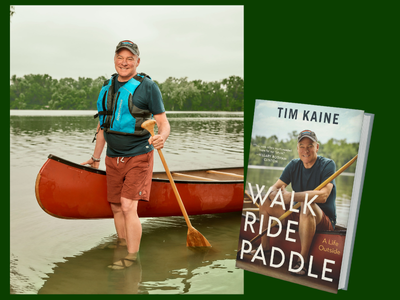
Episode Guest
Tim Kaine, Author & US Senator
“Walk Ride Paddle: A Life Outdoors”
Park Stats
- The Virginia Nature Triathlon:
- Walk: Appalachian Trail, Harpers Ferry, WV to the Tennessee border — Virginia section
- Ride: Skyline Drive + Blue Ridge Parkway, North Carolina to Front Royal, VA
- Paddle: James River, Iron Gate, VA (confluence of the Jackson and Cowpasture Rivers) to Fort Monroe and the Chesapeake Bay
- Duration: 76 days over 30 months (2019–2021)
- Book: Walk, Ride, Paddle by Tim Kaine
Show Notes & Links
- Walk Ride Paddle: A Life Outdoors
- Tim Kaine
- Places & things mentioned in this episode
- Parks
- Towns & cities
- Front Royal,VA
- Waynesboro, VA
- Roanoke, VA
- Damascus, VA
- Marion, VA
- Products
Transcript
Walk, Ride, Paddle: A Life Outdoors with Senator Tim Kaine
The Parks Podcast, Episode 29
Missy Rentz: Today’s guest has many titles — husband, father, U.S. Senator, harmonicist, songwriter, and outdoorsman. In his book Walk, Ride, Paddle, we get to experience all of these roles. Senator Tim Kaine, welcome to The Parks Podcast.
Senator Tim Kaine: Missy, thanks so much for having me on.
The Virginia Nature Triathlon
Missy: I read your book while swinging in a hammock in front of a campfire in a Virginia state park — I feel like I was in exactly the right mood to receive all of it. Walk, Ride, Paddle is about your Virginia nature triathlon: hiking the Appalachian Trail in Virginia, riding your bike along Skyline Drive and the Blue Ridge Parkway, and paddling the entire length of the James River. What was your inspiration?
Senator Kaine: The inspiration was turning 60 in 2019 and celebrating 25 years in public life — my first city council election in Richmond was in 1994. I like to mark milestones.
Around Thanksgiving of 2018, I realized a lot of states have these cool branded adventures. The 46ers in New York — you climb all 46 Adirondack peaks above 4,000 feet. There’s RAGBRAI, the famous bike ride across Iowa. But Virginia didn’t have one. So I thought, why don’t I create one?
As soon as I asked myself what the Virginia epic adventure would be, the answer came pretty quickly: hike the AT from Harpers Ferry to Tennessee, cycle the Blue Ridge Parkway and Skyline Drive from North Carolina to Front Royal, and canoe the James River from Iron Gate — where the Jackson and Cowpasture Rivers meet — all the way to Fort Monroe and the Chesapeake Bay.
It took me 76 days over 30 months, at a very momentous time in American history. But it was truly an amazing journey.
Nature as Refuge During Turbulent Times
Missy: Between 2018 and 2021, a lot changed in the world. When you started dreaming of this adventure, you had no idea what you were about to go through. What role did nature and the parks play in helping you navigate it all?
Senator Kaine: I took my first step at Harpers Ferry in May 2019 and pulled my boat out of the water at Fort Monroe in October 2021. In between: COVID — which I got, and I’m still dealing with mild long COVID — a contested presidential election, the George Floyd protests, and the attack on the Capitol on January 6th.
Never in my life could I have done this trip until now. And never in my life did I need it more.
The time in nature became a real mental refuge. It re-energized me. It gave me a chance to step back from the emergency of the day, put big-picture events into perspective, and think about Virginia history and where these moments fit into our larger story as a people.
It also changed me in a lasting way. I haven’t been back to the Senate gym since I took my first step on the Appalachian Trail. I realized I like to exercise outdoors — no Fox News on one TV and MSNBC on the other, no colleagues pressing in, no weight of work. Now I have gear for all seasons and I exercise outside. The physical benefit is just as good. But the mental benefit is far better.
Missy: You write about the freedom of being disconnected from your phone — and how that carried with you afterward.
Senator Kaine: I kept a cell phone for emergencies and checked email at lunch, but it stayed in a waterproof dry bag in my pack or canoe. No headphones, no music except the harmonica I carried and played at the end of each day. Listening to birds, the sound of the river, the conversations of passersby.
I’m still not as good as I wish I was about disconnecting — but those adventures really helped me stop being so wedded to my phone.
The Community the Trail Creates
Missy: One of the things you write about beautifully is the community — the AT has its own culture, and you also brought your own people with you on the journey.
Senator Kaine: The hike was mostly solo — 42 of the 76 days, I was alone. But the bike trip was a reprise of a ride I’d done with law school buddies 25 years earlier. And on the canoe trip, almost every day I had someone with me. My wife Ann did a third of the river. My kids came. Richmond neighbors, law school friends. I paddled with tribal leaders from the Chickahominy and Monacan nations, whose land is along the James. The James River Association joined me to talk about the river’s ecology.
But the community that really impressed me was what has grown up around the Appalachian Trail. The hikers, the trail maintainers, the clubs, the shuttle drivers, the trailside towns — Front Royal, Waynesboro, Roanoke, Damascus. Communities that have genuinely adjusted their life around these natural assets and become real havens of welcome.
When you’ve been hiking all day and you get to a town, you’re so grateful for a shower and a cold Dr. Pepper. Those towns are great places.
Nanny and North Bend Plantation
Missy: One story that really moved me was Nanny, from your paddle trip. Would you share it?
Senator Kaine: Nanny is the owner of North Bend Plantation, a B&B in Charles City County — downstream from Richmond on the James, not far from where the earliest Virginia plantations were built in the 1600s.
I was canoeing and needed a place to stay. I started calling plantations, not sure if any offered rooms. Eventually I reached North Bend. A woman answered, checked her book, and said yes. I showed up looking like a river rat — swimsuit, t-shirt, baseball hat — and a woman came out and said: “My name is Ridgely, but everybody calls me Nanny, because I’m going to treat you like your grandmother while you’re here.” And she did.
The land at North Bend has a layered history. The Union set up there to build a massive pontoon bridge across the James during the Civil War. But Nanny also told me about the history of slavery on that land — and what her family chose to do about it.
When Nanny retired as a psychiatric mental health nurse, she was driving around feeling an emptiness, looking for a sign. She noticed a banner for a Wednesday night Bible study at a predominantly African American Baptist church nearby. She started attending. She loved it so much she brought her husband. They became deeply connected to that congregation.
One Sunday, Nanny and her family invited the entire church to worship on the grounds of North Bend. At the end of the service, they stood up and surprised everyone. They asked for forgiveness — for the sin of slavery that had been practiced on that land.
The pastor turned to the congregation: “Church, we’ve been asked for forgiveness. What do you think?” The congregation said yes. Then the pastor said: “And for any of us who have harbored resentment or hatred in our own hearts — maybe we should ask for forgiveness too.”
A few years later, Nanny’s husband died. He was buried at Westover Episcopal, as generations of his family had been. The sermon was preached by the pastor of that Baptist church they had stumbled into.
I don’t know exactly what I was looking for when I started this journey. But what I found were people like Nanny — people who have genuinely changed my life.
Inclusion and Diversity in the Outdoors
Missy: You didn’t shy away from the hard history in this book — Fort Monroe, the history of slavery along the James. And you talk about inclusion in the outdoors. There’s a long-standing perception that parks are only for certain people. You’re a strong advocate for changing that.
Senator Kaine: As I traveled, I noticed I didn’t see the diversity on the trails that I wished I did. And it took me a while to understand why.
These parks are accessible in the sense that they’re affordable. But a lot of people are not frightened by bears or snakes. They’re frightened by how other people will treat them — out in the middle of nowhere, far from anyone who might help them.
That is one of the real reasons some of these natural spaces aren’t diverse. It’s not that people don’t want to be outdoors. It’s that they don’t feel safe being outdoors. And those of us who care deeply about the outdoors have some work to do.
Missy: What can outdoor people do to make these spaces more welcoming?
Senator Kaine: Let me start with a success: fishing. Fishing is one of the most culturally universal experiences in the world. If you go down to the James River in Richmond on a nice day — the Mayo Bridge, Ancarrow’s Landing, Rockets Landing — the people fishing are like a United Nations. Every language, every country. Because everyone fishes everywhere.
And then: young people. If you get a young person hooked on being outdoors, they’ll be a steward of the outdoors for their entire life. That was true for me with Boy Scouts. My parents weren’t campers — they liked picnics. But I got into camping through scouting in early middle school and got completely hooked. Then I convinced my parents we needed a tent. They got into it. My brothers got into it.
So many organizations are doing this well — the James River Association runs river trips for kids, the James River Park System has great programming, Junior Ranger programs in the parks are a real entry point. But maybe there’s more we can do. Get young people outside and they’ll protect these places for generations.
Lessons from the Trail
Missy: What tools and attitudes from the journey have stayed with you in everyday life?
Senator Kaine: Being outdoors with people — Democrats, Republicans, mostly people whose politics you’d never know — reminded me how much of life we actually share. Politics can be divisive. That’s true. But we all appreciate the outdoors. We all hope our kids and grandkids have access to a sunset or a beach or a trail. Being in nature puts that into perspective. It doesn’t make the division disappear. But it shows you we’re not as divided as the news might make it seem.
Missy: One of my favorite lines from your book: “A plan is good. So is being flexible.” And the hiker wisdom — hike your own hike.
Senator Kaine: Two or three days in, I was pushing to make mileage to a certain spot. But I came across a beautiful camping site and thought — this isn’t a race. I stopped early. A bad storm hit that night. I was dry. Had I kept going, I might not have been.
I get enough stress in my own life. Being outdoors is supposed to take away stress, not add it. Hike your own hike. Nobody else’s.
Protecting Our Public Lands
Missy: There’s a huge movement right now of people rallying to protect public lands. What can we do to best support that effort?
Senator Kaine: Public lands are bipartisan — that’s genuinely good news. And I would say: call your federal legislators right now. Senators, House members. Tell them: please protect parks funding, outdoor funding, public land funding.
The National Park Service has been laying off seasonal and probationary employees. The Forest Service has too. That reduces their ability to keep parks in the shape they need to be in. Nobody wants to find trailheads that are closed or trash cans that are overflowing. We need adequate staffing and budgets to maintain these places for everyone.
The outdoor community is big and passionate. Use that. Make the calls.
Speed Round
Missy: We end every episode with a speed round — just answer with whatever comes to mind first.
Earliest park memory? Boy Scout camping on a farm south of Kansas City. And Shawnee Mission Park near where I grew up — a lot of picnics there.
What made you love the parks? Cooking outdoors. We had an old beat-up Coleman stove. The same meal on a Coleman stove at a picnic table tastes so much better than it does anywhere else.
Favorite thing to do at a park? Hike.
Park on your bucket list? Glacier National Park. My wife and I are taking our 40th anniversary trip there this summer.
Three must-have items for a park visit? Harmonica — I love playing music around the campfire. Coffee. And my Nemo insulated sleeping pad — I used it on the AT and it was a true lifesaver. I sometimes inflate it and sleep on the floor at home when it’s too hot.
Favorite campfire activity? Playing music and singing.
Tent, camper, or cabin? Tent.
Trekking poles or no poles? I’ve graduated from no poles to one pole to two. If it’s intense terrain, two poles now.
Favorite trail snack? Mini Heath Bars. Mini — not many. Although also many.
Favorite animal sighting? Black bears in Shenandoah National Park. They always surprise you and they never get old.
Favorite sound in a park? Birds or rushing water. My wife can identify birds by sound — I can hear them far away but can’t tell you what they are. She’s the expert.
Greatest gift the parks give us? A future that will hopefully look like the past. I want these places to be there for my great-great-great grandkids — to give them the same feeling of joy and spiritual renewal they give me now. If we work together to protect our public lands, we’re not just preserving places. We’re preserving a future of memories for generations to come.
Missy: Senator Kaine, thank you for opening up about your adventures — and for everything you do for our public lands.
Senator Kaine: Thank you, Missy. And thanks for the work you do to make parks and the outdoors feel accessible to people who are maybe coming to it for the first time.
Missy: Until next time — we’ll see you in the parks.
Music for The Parks Podcast is performed and produced by Porter Hardy. Follow us @TheParksPodcast or visit TheParksPodcast.com.