
Shenandoah National Park sits just 75 miles from the nation’s capital, home to the most popular road in the national park system and more than 516 miles of trails. But the park’s creation story is more complicated than most visitors realize — 500 families were displaced to make way for it, and the forest most people fall in love with today was planted by Depression-era young men from the Civilian Conservation Corps. Interpretive Ranger Carl Rand joins The Parks Podcast to explore all of it — the history, the wildlife, the fall foliage, and how to plan a visit whatever the season.
Episode Guest
Karl Rand, Park Ranger, Interpretation
Shenandoah National Park
Park Stats
Location: Blue Ridge Mountains in western Virginia
National Park Number: 22nd
Park established: December 26, 1935
President in office: Franklin D. Roosevelt
Park size: 198,000 acres
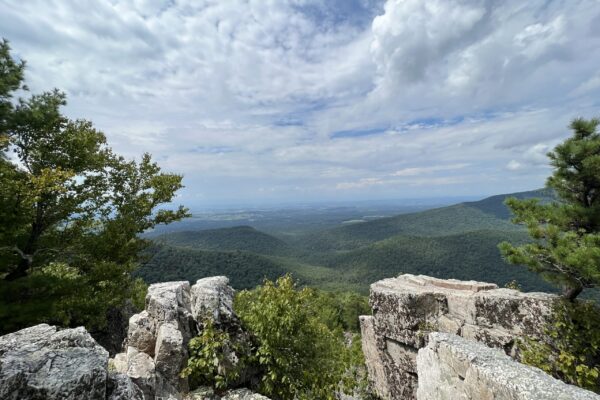
Highest elevation: 4,050 feet – Hawksbill Mountain
Lowest elevation: 550 feet
Visitors: 1,449,300 in 2022
Fun fact:
-
- Utilized the Civilian Conservation Corps when it was created
- 516 miles of hiking trails, 101 of those is along the Appalachian Trail
- 12+ waterfalls
- Common animals include black bear, coyote, skunk, raccoon, and foxes
- 196 species of birds
- 41 species of fish
Show Notes
SHOW NOTES & LINKS
- Plan Your Visit — Shenandoah National Park
- Four entrance station GPS addresses
- Skyline Drive information
- Hiking trails and maps
- Ranger programs and calendar
- Dickey Ridge Visitor Center
- Harry F. Byrd Sr. Visitor Center — Big Meadows
- Dog-friendly trails at Shenandoah
- Annual Night Sky Festival — August
- Artists in Residence program
Transcript
Shenandoah National Park — History, Wildlife, and Coming Home
The Parks Podcast, Episode 3 | Carl Rand, Interpretive Park Ranger
Missy Rentz: Today we welcome Carl Rand, an interpretive park ranger at Shenandoah National Park. Carl has been with the National Park Service since 2017, working at Yellowstone and Olympic before heading east. Since 2021, he’s been based primarily in the Big Meadows area of the park. Carl, welcome to The Parks Podcast.
Carl Rand: Thank you very much. It’s a pleasure being here.
Why Shenandoah Matters — Eastern Parks in Western Tradition
Missy: Shenandoah was only the second national park on the eastern seaboard when it was created. Why was that such a big deal?
Carl: The push for eastern parks really began in the early to mid-1920s, and the driving idea was: bring the parks to where the people are. Before that, if you wanted a national park experience, you were spending weeks and significant money traveling out West. But millions of people were living on the eastern seaboard.
Shenandoah is at best an hour’s drive from Washington, D.C. We get visited by government officials regularly. Being so close to the White House and the Department of the Interior, a lot of other parks look to us to set precedent. Herbert Hoover even made his summer home — what he called the Brown House — right here in Shenandoah. It’s been a presidential stomping ground ever since.
The CCC and the Forest You’re Walking Through
Missy: The Civilian Conservation Corps played a huge role in creating the park. What did they actually do here?
Carl: When we became a national park in 1935, the landscape looked very different. Human activity — cattle grazing, timbering, copper mining — combined with the loss of the American chestnut tree in the early 1900s had drastically altered the land. There were large open areas of standing dead trees.
Today, about 94% of Shenandoah is woodland. But most of that forest was planted by the CCC.
Shenandoah was the very first national park to have Civilian Conservation Corps camps — ten of them, with about 200 young men at any given time. They installed hiking trails, constructed buildings, and built the infrastructure for the park. But most importantly, they planted thousands upon thousands of trees.
Visitors sometimes notice the trees don’t seem as large as they should be for an old-growth forest. That’s because they’re only 70 to 80 years old — either planted by the CCC or secondary growth from those trees. The wilderness you’re walking through is, quite literally, their work.
Missy: And the CCC was created during the Depression?
Carl: The story starts in 1929 with the stock market crash. When FDR came in, his New Deal was full of work programs. The CCC required you to be a young man, physically fit, unmarried. You’d spend six to nine months doing hard labor in national parks, forests, and state parks.
The pay was $30 a month — equivalent to about $550 today. But only five of those dollars went to the worker. The other $25 were mailed home to help their families and supplement the broader economy.
The Families Who Were Displaced
Missy: This park was not created without controversy — and I appreciate how the National Park Service embraces that history.
Carl: It’s an important story to tell — and it’s not just Shenandoah’s story. It’s the story throughout Appalachia.
Before the park was established in the 1930s, approximately 500 families of mountain community residents lived on what is now Shenandoah. Tourism was already in the area — Skyland Resort, which still stands today, was already operating. But to assemble the roughly 3,000 tracts of land that make up the park, the Commonwealth of Virginia had to acquire all of it.
Some residents owned their land and were bought out. Many were provided relocation housing. But many others — tenant farmers who had lived on these mountains since the early 1740s — had no deed in the eyes of the state. They were simply there, tending land owned by cattle ranchers in the valley. When the state purchased that land, they had no legal claim and no other option but to leave.
The harder part of this story is what happened to public perception at the time. Sociologists were brought in to study the mountain communities. What they wrote and published later was largely unfounded — stories of uncivilized, uneducated people without churches or markets. Most of it wasn’t true. But it shaped public opinion and made the displacement more accepted among the general population.
That stigma stuck. It’s part of where the idea of “hillbillies” and “hollow folk” comes from. And it started right here.
When you read those stories and then see how beloved this park is today, the progress is remarkable. But the full history deserves to be told.
Skyline Drive — The Most Popular Road in the National Park System
Missy: Skyline Drive is part of Shenandoah National Park?
Carl: It is. The drive stretches 105 miles north to south along the backbone of the park. Where it leaves our south district, it connects to the Blue Ridge Parkway. But Skyline Drive itself is entirely within Shenandoah.
It’s busy any day of the year, but late September into early October is our absolute peak — the leaves are changing and people come to the mountaintop to be surrounded by corridors of reds, oranges, and yellows. The speed limit is 35 miles per hour throughout, and honestly you wouldn’t want to go faster. There’s too much to take in.
Art in the Park — Artists in Residence
Missy: Tell me about the Artists in Residence program.
Carl: Art has been part of the National Park Service since Yellowstone. Here at Shenandoah, we bring in five artists each year — musicians, painters, quilters, papermakers. They stay for four to six weeks, live on the premises, give public programs and demonstrations, and use their art to tell the story of the park.
It’s another form of accessibility. Not everyone can hike a trail or drive Skyline Drive. But art can reach people who are experiencing the park from home, from their couch, from anywhere. It shares every dimension of Shenandoah — the wildlife, the history, the landscape — in a completely different way.
Planning Your Visit — Where to Start
Missy: Shenandoah is 105 miles long with four entrance points. How do visitors even begin to figure out where to go?
Carl: Start with where you’re coming from. Each entrance point is near a local town, so knowing what town you’re passing through is a natural starting point. And do not just plug “Shenandoah Visitor Center” into your GPS — we have roads that show up on maps that aren’t actually roads. Use the official GPS addresses for our four entrance stations, which you’ll find on nps.gov/shen.
Once you’re in the park, stop at a visitor center and talk to a ranger. We have two: Dickey Ridge in the north district, just five miles into the park, and the Harry F. Byrd Sr. Visitor Center at Big Meadows, near mile marker 51 in the center of the park. We have 14 different trail guides covering the full 516 miles of hiking. We can help you plan a backcountry trip or just figure out where to go next.
The website is also excellent — there’s a dropdown for every type of recreation, from fly fishing permits to backcountry camping to ranger program schedules.
What to keep in mind:
- Weather changes fast on the mountain. Check forecasts before you go.
- Bring more water than you think you need. Water stations are far apart — don’t count on filling up along the way.
- Don’t drink from streams, no matter how clean they look. It’s still wild water.
- Know your own capability. There are lovely family-friendly trails here, but it doesn’t take long to find 2,000 feet of elevation gain or a 15-mile loop. Know what you’re getting into.
- You’re gaining about 4,000 feet of elevation from the valley. Even if you’re accustomed to altitude, heat and humidity can hit people differently up here. Check in with yourself.
When to Visit — There Is No Bad Time
Missy: When is the best time to come?
Carl: It’s an impossible question to answer — because every season offers something completely different.
Spring (April–May): Waterfalls coming back to life, spring wildflowers in full bloom. Summer (June–July): Wildlife in peak activity — bear cubs, fawns, snakes in breeding season, songbirds everywhere. Late August: Goldenrod blooms — a second wave of wildflowers. Fall (late September–early October): Peak foliage. Our absolute busiest season. Corridors of color along Skyline Drive. Winter: A completely different park. Ice formations on the trees, deer in the snow, songbirds that stay year-round. Fewer people, profound quiet on the mountain. We only close Skyline Drive for severe ice or snow — otherwise the park stays open.
There is no bad time to come here.
Wildlife — More Than You Expect
Missy: I’ve visited Shenandoah many times and somehow never focused on the wildlife. What should people know?
Carl: There’s an enormous diversity of animals here, and they’re active at different times of year. Right now in early summer, the bear cubs are out, fawns are being born, and rattlesnakes are in breeding season — so snake activity is high. (I love reptiles, so I love seeing them from a safe distance.)
This is also a very popular birding park — nearly 200 species. One of my favorites here is the veery, a thrush with a two-toned call that lets it harmonize with itself. It sounds like something out of a science fiction film.
And bobcats — we call them the ghosts of the forest. You don’t see them unless they let you. But in the quieter South District, if you’re driving at just the right time in the evening, one might pass in front of your car. It’s one of the best wildlife moments the park offers.
Big Meadows
Missy: You work primarily in the Big Meadows area. What should visitors know about it?
Carl: Big Meadows is a 135-acre wetland meadow — diverse grasses, sedges, mosses, lichens, standing oaks, flowering plants. It’s beautiful in every season.
What I love talking about is how much it’s changed. When we became a national park in 1935, the meadow was over a thousand acres. As the forest protection kicked in and the CCC trees matured, the forest gradually reclaimed most of it. What you see today is just 135 acres of what was once a massive open landscape.
Dogs at Shenandoah
Missy: Shenandoah is one of the more dog-friendly national parks. What do dog owners need to know?
Carl: Of our 500+ miles of trails, only about 20 miles across nine individual trails don’t allow dogs. Those restrictions exist either because the terrain is dangerous for paws — sharp scrambling rock — or because the trail is too narrow and heavily trafficked to safely accommodate both people and dogs.
On all other trails: dogs must be on a leash, and the leash must be six feet or shorter. That’s for the safety of other visitors, but also for your dog. Black bears and dogs are natural adversaries. We’ve never had a true bear attack on a visitor since becoming a national park, but keep your dog close and your eyes open.
Shenandoah does not currently have the Bark Ranger program, though many other national parks do.
The Night Sky
Missy: You have a Night Sky Festival even though you’re not an officially certified dark sky park?
Carl: We’re not officially certified — that requires specific lighting standards and proximity requirements we can’t fully meet. But the geology of the Blue Ridge Mountains creates a natural barrier against light pollution from the surrounding region. On most clear nights, you can see the Milky Way from Shenandoah.
We hold our annual Night Sky Festival in August, usually timed around the Perseids meteor shower — this year it’s August 11th and 12th. We bring in guest speakers and run dark sky programs with night sky rangers. It’s one of the most remarkable things you can experience here.
Speed Round
Missy: We end every episode with a speed round — just answer with whatever comes to mind first.
Earliest park memory? Growing up, my family visited Yellowstone often — my uncle was a law enforcement ranger there. My earliest memory is riding in on a snowmobile behind Santa Claus himself on Christmas. My aunt made homemade chocolate ice cream to celebrate. It turned out to be Hershey’s syrup poured over churned snow. I have never fully forgiven her.
What made you love the parks? Not the chocolate ice cream. Watching my uncle’s career and hearing his stories. I studied wildlife biology and worked at a zoo, but eventually I needed more topography in my life. I thought of my uncle and applied to the Park Service. My first job took me back to Yellowstone. I’ve never looked back.
Favorite thing about Shenandoah? The history. That’s never been my background — I came here for the wildlife. But I’ve found it’s impossible to talk about these parks without talking about the people. The mountain communities, the CCC, the Native Americans who were here long before any of us — there are so many layers to this place and being able to share those stories is what I’ve fallen in love with most.
Favorite thing to do at the park? Hiking. My wife and I just celebrated her 30th birthday by piecing together a 30-mile day hike. She’s the crazy one. I just went along for the ride.
Park on your bucket list? Glacier National Park. Big wilderness, massive peaks, glaciers, and grizzly bears. I’m a sucker for bears.
Three must-haves for a park visit? Extra water — at least double what I think I’ll need, or a water filter for streams. A map — either a topographic fold-out or the handout from the visitor center. And a plan — I always text someone before I head out and tell them when to expect to hear from me. If they don’t, they know to start asking questions. And if I could add a fourth: a good appetite.
Favorite campfire activity? Pie iron pizza. You take a cast iron mold on the end of two poles, load it with sandwich bread, pizza sauce, cheese, and any topping you want — even cherry pie filling for dessert — and hold it over the fire until it’s golden and crispy. It’s a pizza sandwich and it is incredible. (Recipe going in the show notes.)
Tent, camper, or cabin? Tent. We’re big into backpacking.
Trekking poles or no poles? I hike without — but I strongly encourage anyone with risky knees to use them.
Favorite trail snack? Dried mangoes.
Best animal sighting? In Shenandoah: bobcats. You almost never see them, which makes it extraordinary when you do. Out West: a bull moose at Yellowstone that stepped out of the trees about 15 feet from us while my wife was — let’s say — loudly expressing that she had twisted her ankle. The moose looked at her, seemed confused, and then grazed his way down the trail. We watched him for half an hour.
Favorite sound in a park? Rushing water. Shenandoah has about 90 streams flowing off the mountain — feeding the Shenandoah River to the west and the James and Rappahannock to the east. You’re almost never out of earshot of moving water here. That’s where I’m most at peace.
Missy: Carl, thank you so much for sharing your love of Shenandoah with us.
Carl: Thank you for letting me share. Until next time — see you in the parks.
Music for The Parks Podcast is written, performed, and produced by Porter Hardy. Follow us @TheParksPodcast or visit TheParksPodcast.com.