
New River Gorge became America’s newest national park in 2020 — but the story here goes back 10,000 years. This is where the coal that fueled the industrial revolution came from. Where Henry Ford leased mines and Carter G. Woodson — the father of Black History Month — worked as a coal miner. Where one day a year, people from around the world come to jump off the longest steel arch bridge in the Western Hemisphere. Eve West, Chief of Interpretation and Education at New River Gorge National Park and Preserve, joins The Parks Podcast to peel back the layers of a park that keeps revealing more the deeper you go.
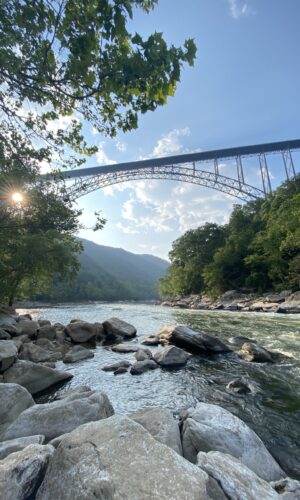
A note from Missy: I drive through this area often and love to stop for a short hike to the bridge. It’s frequently deep in the fog — and somehow that makes it even more beautiful. This is a park that rewards every kind of visitor, from the casual drive-through to the week-long adventure seeker.
Episode Guest
Eve West – Chief of Interpretation
New River Gorge National Park
Park Stats
- Location: North of Fayetteville, West Virginia
- Designation: National River 1978; redesignated National Park and Preserve 2020
- Park number: 63rd National Park — America’s newest
- Size: 70,000+ acres across four counties
- Annual visitors: 1,811,937 (2024)
- The bridge: New River Gorge Bridge — longest steel span arch bridge in the Western Hemisphere; third highest bridge in the United States
- Trails: 100+ miles of hiking and biking trails; 13 miles of dedicated mountain bike single-track
- Wildlife: 65 mammal species, 10 bat species, 40 reptile species, 50 amphibian species
- The river: One of the oldest rivers on the continent
- Park and Preserve: ~90% preserve (hunting allowed in season); ~10% national park
- Notable: Only national park where BASE jumping is permitted — one day per year
Show Notes & Links
- Plan Your Visit — New River Gorge National Park
- Canyon Rim Visitor Center
- Sandstone Visitor Center
- Hiking and biking trails
- Whitewater rafting outfitters
- Rock climbing information
- Bridge Day — third Saturday in October
- Bridge Walk — walking underneath the New River Gorge Bridge
- Gauley River National Recreation Area
- Friends of New River Gorge National Park and Preserve
- Accessibility at New River Gorge
- Camping — Recreation.gov
- Charleston, WV International Airport — 55 minutes from the park
Transcript
New River Gorge National Park & Preserve — America’s Newest National Park
The Parks Podcast, Episode 34 | Eve West, Chief of Interpretation and Education
Missy Rentz: We are so happy to welcome Eve West, Chief of Interpretation and Education at New River Gorge National Park and Preserve. Eve, welcome to The Parks Podcast.
Eve West: Well, thank you. I’m very happy to be here.
The Onion Park — More Layers Than You Expect
Missy: This park is what I call an onion park. I went there for one thing and just kept peeling back layers and finding more and more. And even preparing for this episode, there’s more I want to see.
Eve: People think of parks like the Smokies — biologically and botanically diverse — and New River Gorge is that too. But it’s still fairly new to the National Park Service, and science is still catching up here. When we say 65 species of mammals, that’s what we know about. There may be more. We are still a relatively unstudied resource, and we’re learning new things about this place every day. If you are a naturalist of any discipline, you can find a niche here.
Why It Matters — And What “Park and Preserve” Means
Missy: It was a National River for 47 years before becoming a national park in 2020. Why does that designation matter?
Eve: A friend of mine who works at the Smokies said it to me once — “you guys have it all.” And it’s kind of true. Spectacular scenery, geological story, natural history, botanical diversity — but also tremendous recreational opportunities. Rock climbing, mountain biking, river rafting, zip lining, hiking. If you like being outside and active, you can find it here. I always say: if you get bored here, the problem isn’t with the place.
Missy: And it’s a park and preserve — what does that mean?
Eve: When they were working to redesignate this from a national river to a national park, they realized that a straight national park designation would eliminate hunting, which has been a traditional use of this land for generations. To protect that tradition, they chose the national park and preserve designation — one of only two in the lower 48, the other being Great Sand Dunes in Colorado. About 90% of the park is considered national preserve, where hunting is allowed in season. The other 10% is national park, where it is not.
The History — Deeper Than Most People Know
Missy: The history here goes far beyond what most visitors expect.
Eve: It really does, and it goes in a lot of directions. George Washington came through this area as a young surveyor, long before there were any political aspirations. The history goes back to prehistoric peoples as well. But there are two stories I always love to share that most people don’t know.
Henry Ford leased the coal mines here at Nuttallburg from 1920 to 1929 to fuel his automobile industry in Dearborn, Michigan. The infrastructure he built was state of the art — including an innovative system that moved coal from the mine level down to the river where the trains ran, essentially a large chute dropping from the bench above. He eventually gave up the lease in 1929 because he couldn’t control the railroad schedule, which disrupted his business model.
And working those same mines was Carter G. Woodson — the father of Black History Month — who was a coal miner here.
Mother Jones also had a tremendous impact here on workers’ rights. So when you’re walking through this landscape, you’re walking through the labor movement, the industrial revolution, and African American history all at once.
The Coal Industry That Shaped the Gorge
Missy: Tell me about Thurmond and Nuttallburg — the towns that coal built.
Eve: Thurmond in 1910 had more freight revenue passing through its depot than anywhere else on the entire Chesapeake and Ohio rail line. That’s hard to imagine when you see it today — but the railroad was the interstate highway of its era. In fact, there was a train track in Thurmond before there was a highway. A train bridge before a highway bridge.
Thurmond was also a destination. Across the river was the famous Dunglen Hotel — the equivalent of what the Greenbrier is today. A large, celebrated resort where coal barons arrived and entered the New River coalfields. The town had fresh fish from the Chesapeake delivered daily, newspapers from Chicago. It was a booming, self-sustaining community.
Nuttallburg’s story begins with a man named Thomas Nuttall who was traveling through the area and stopped at a small pub where he noticed the fire was producing no smoke. That was the smokeless coal of the New River Gorge — one of the purest coals ever mined, so clean it fueled Navy ships without producing visible exhaust. Nuttall changed his plans, stayed, and built the town. The Nuttall family still lives in the area today.
The coal here was so pure it was often converted into coke — a more refined fuel used to fire the steel mills of Pennsylvania and beyond. New River coal is considered to have fueled the industrial revolution.
The Recovering Forest and the Carbon Sink
Missy: The website talks a lot about the changing forest. What’s happening here ecologically?
Eve: In most cases, it’s a recovering forest. When the railroad was completed in 1873 and the coal towns started growing, timber was harvested heavily to sustain them. The forests were essentially stripped in many areas. Almost everything you see here now is second growth.
What’s remarkable is how completely this land has bounced back. Stand at the Grandview overlook and look out — you would never guess that area had been logged. But it had been. The resilience of this land speaks to both its natural vitality and the conservation attitudes of the people who live here.
New River Gorge is also considered a carbon sink — the whole region absorbs carbon because of the density of its forests. Look at a nighttime satellite map of the eastern United States and you’ll see all the lights of the eastern seaboard — and then a large dark area. That’s West Virginia. That’s this place.
Invasive Species — A Constant Battle
Missy: The park website has a whole section on invasive species. It’s a topic we’ve never covered on this podcast.
Eve: It’s a constant battle, and it’s not unique to us — but it’s very present here. New River has roughly 1,500 native plant species and about 200 non-native ones. Some of those non-native species are more aggressive than others, and they can choke out natives and engulf cultural resources. Old stone fences, historic structures — you’ll find them covered in kudzu and other invasives.
We try everything. We’ve even brought in goats to eat certain plants in targeted areas. We use biological controls where we can. But eradication is probably not realistic — maintenance is the goal.
What individuals can do to help: buy firewood locally and don’t bring it from out of state. Seeds, insects, and plant material you don’t even know you’re carrying can introduce new invasives. Even check your clothing after hiking in one region before going to another. It sounds small, but it matters. A lot of the invasive species along New River’s railroad corridors came in exactly that way — seeds blowing off passing trains.
Planning Your Visit
Missy: New River Gorge is intimidating to first-time visitors because it doesn’t work like a traditional park. How do people approach it?
Eve: The most important thing to understand is that this is not a traditional park. There’s no one road that goes all the way through. No scenic drive along the river. No single trail end to end. It’s long and skinny along a river corridor, with many entrances and exits. You’re in and out. Look for the brown and white arrowhead signs — that’s your guide.
Start at a visitor center. Canyon Rim Visitor Center near the New River Gorge Bridge is our busiest — it’s actually the most visited spot in the entire park. Sandstone Visitor Center covers the southern end of the park. Both have rangers who can help you figure out the best use of whatever time you have, whether it’s a few hours or a week.
The four areas we always suggest:
- Lower Gorge / Canyon Rim — the bridge viewpoints, Canyon Rim Visitor Center, the boardwalk
- Thurmond — the historic railroad town and coal district, accessible by car or by Amtrak (it’s an active flag stop on the Cardinal line)
- Grandview — the highest overlook in the park, 1,400 feet from rim to river, with sweeping views of the gorge
- Sandstone Falls — the largest waterfall on the New River, with a wheelchair-accessible boardwalk
Getting here: New River Gorge is five and a half hours from D.C., four hours from Pittsburgh, three hours from Lexington, and six to eight hours from New York City. Charleston’s Yeager Airport is 55 minutes away. Beckley has its own smaller airport with flights from Charlotte. And you can take the Amtrak Cardinal and get off right in Thurmond — just arrange transportation in advance.
Where to stay: The park’s campgrounds are primitive — no water, no electricity. If you need hookups, look at the surrounding state parks or private campgrounds. Beckley has the most chain hotels and is centrally located. But there are also abundant Airbnbs, VRBOs, glamping options, and local Airbnbs throughout the gateway communities of Fayetteville, Hinton, Oak Hill, and Prince.
Important for large vehicles: Check the park website carefully before you go. Some roads are not suitable for large vehicles — the website is excellent about flagging this. Plan your route before you arrive.
Parking at peak times: There’s no entrance reservation system yet, but popular trailheads fill up completely on busy weekends — Memorial Day weekend in particular. Come early, be flexible, and know your backup options.
What to Do — The Wild and the Mild
Eve: Whatever you like to do outdoors, you can probably find it here.
Whitewater rafting: Class IV and V in the lower gorge. The saying is it’s Class IV as long as you stay in the boat — if you fall out, it can quickly become Class V due to undercut rocks. Go with an outfitter unless you’re experienced. For quieter water, the upper New has tubing and duck boats.
Rock climbing: One of the premier rock climbing destinations in the eastern United States, with routes from beginner to expert. Outfitters available.
Mountain biking: One of the few national parks that allows biking on trails. There’s a long rail trail plus 13 miles of dedicated mountain bike single-track — rare in the national park system.
Fishing and hunting: Both allowed with West Virginia state licenses, in designated areas and seasons.
Swimming: Possible but not encouraged — the New River has significant undercurrents. For family-friendly swimming, Lake Summersville just north of the park is the better option.
Extreme whitewater: Gauley River National Recreation Area, also administered by New River Gorge, is considered one of the top 10 whitewater rivers in the world.
Bridge Walk: A private company called Bridge Walk offers two-hour guided walks underneath the New River Gorge Bridge, available throughout the year. A remarkable experience.
Bridge Day — The One Day You Can Jump Off
Missy: Tell us about Bridge Day.
Eve: Bridge Day is the third Saturday in October — and yes, people jump off this perfectly good bridge. It’s one of the top 10 high-adventure events in the world, and the only national park where BASE jumping is permitted. The bridge closes from 7am to 5pm. The event runs 9am to 3pm with vendors on both sides, jumpers from around the world — you’ll hear French, German, languages from everywhere — and BASE jumpers landing on a targeted zone far below, with boats ready if they land in the river.
You can also purchase a tandem jump, or watch rappellers and zip liners going off the side. Attendance can reach over 100,000 people in a single day.
Even if jumping is not your thing, watching it is an extraordinary experience. The combination of natural beauty, engineering spectacle, and sheer human courage all in one view is unlike anything else.
Accessibility and Dogs
Eve: We are a pet-friendly park — dogs on a leash six feet or shorter are allowed on trails. We also have a Bark Ranger program. And we’re launching a new program with a local animal shelter to offer foster dogs for day hikes in the park. That’s just getting off the ground.
For accessibility: the park is actively improving, but as a five-year-old national park, it’s still evolving. Sandstone Falls boardwalk is fully wheelchair accessible. Canyon Rim boardwalk provides good bridge views. Grandview’s main overlook has a historic CCC flagstone path with a viewing platform — doable for many, but it depends on your equipment and abilities. Check the accessibility page on the website before you go — it lists every accessible option by area and is very well organized.
The Friends Group
Eve: If you want to help the park, join the Friends of New River Gorge National Park and Preserve. They’re young, they’ve just hired their first full-time executive director, and they do things for this park that the National Park Service simply can’t do on its own. Their website has everything you need to join or get involved.
Speed Round
Missy: Speed round — whatever comes to mind first.
Earliest park memory? Growing up right outside the Buffalo National River — the very first national river ever established, on March 1st, 1972, exactly 100 years to the day after Yellowstone. My earliest memory is being a little kid learning to swim in that river.
What made you love the parks? Growing up next to one helped. But when I started working for the Park Service, I fell in love with the mission. It’s rare to work a job where you genuinely feel like you’re making a difference. I feel very blessed to have that.
Favorite thing about New River Gorge? The diversity. I love plants — just walking through the woods identifying different species. There’s so much about this place I haven’t learned yet. It’s a lifelong learning opportunity.
Favorite thing to do at the park? Walking in the woods. I love mountain biking and trail running too — though the trail running is becoming less frequent as I get older. Being in the forest is just a good feeling.
Park on your bucket list? Denali. I want to get to the Alaskan parks.
Three must-haves for a park visit? A map. A water bottle. And duct tape. You never know when you’re going to need it.
Favorite campfire activity? S’mores. Hands down.
Tent, camper, or cabin? Tent — especially if you can open the top and look at the stars. Depending on the mosquitoes.
Trekking poles or no poles? Without, usually. Though on New River’s rocky, elevation-heavy trails, there are plenty of times I wish I had one.
Favorite trail snack? Protein snacks. I lean toward protein on the trail.
Best animal sighting? Working at Cape Cod in winter, seals came down from the north and gathered just offshore. One day the seals were out there, diving seabirds were bombing the water, everything was happening at once. A completely free wildlife show right in front of me. I thought: am I the luckiest person in the world?
Favorite sound in the park? Raptors. That high-pitched eagle call. You don’t hear it often enough, which makes it all the more powerful when you do.
Greatest gift the parks give us? The word recreation comes from the word re-creation. Parks give us the chance to recreate ourselves — to bond with other people and find harmony. In this moment in time especially, I think that matters more than ever.
Missy: Thank you so much for sharing this incredible park with us, Eve.
Eve: It’s a nice place to talk about. It comes from the heart.
Missy: Until next time — we’ll see you in the parks.
Music for The Parks Podcast is performed and produced by Porter Hardy. Follow us @TheParksPodcast or visit TheParksPodcast.com.