
Episode Guest
Jenny McCarty
Sage Leaf Studio
Speed Round
What is your earliest park memory?
My earliest park memory is at Great Sand Dunes National Park. My family goes there most years in the spring when sometimes it snows too. So it’s not really balmy. But I re I must have been nine or 10 maybe, and we were there with several other families and we’re all sitting around the campfire and the kids are.
Playing and the parents are having a good old time. And it just was a place where we’d all get together and it felt like there were no other cares in the world. Everyone seemed to be having a great time.
What made you love the parks?
I think for a lot of people, it’s a connection to nature. For me, it’s family memories. I. I definitely feel in my family that National Parks are a legacy. My grandparents took my dad and his five siblings to Yosemite. Multiple times in a little Shasta trailer. And then my dad in his younger years, spent a lot of time through Wyoming and Montana and the West, exploring and working odd jobs, being a ski bum.
And then he instilled that love of National Parks and us. And so my brothers and I were very lucky to visit National Parks with him all over. The Continental West and now today we still travel to National Parks. My, my dad books, us trips and we go, and now my siblings have kids and so the grandkids are there too.
And it’s just, it’s a legacy thing. Very strong family bonding time and memories there.
What is your favorite thing to do in in a park?
In a weird way, a lot of park time is people, time for me, usually when I’m going to parks, it’s with other people. When I’m going out on a hike by myself, surprisingly, it’s not usually to a National Park. So it’s quality people time.
What park have you yet to visit but is on your bucket list and why?
White Sands National Park because it’s a. Close one that we could get to and it looks beautiful and like it belongs on another planet and gates of the Arctic because that would be such a high lofty goal of a National Park to get to. It is way up there.
What are three must-haves you pack for a park visit?
I’m gonna say my camera. I have a travel paint kit, which I love to bring, and a good sun hat.
What is your favorite campfire activity?
S’mores eating well, mostly. Yeah, definitely. Eating s’mores
Tent, camper, or cabin?
Tent
Hiking with or without trekking poles?
Without trekking poles.
What is the favorite animal sighting that you’ve had?
The pica squeak is so cute.
What is your favorite sound in the parks?
Oh, you have to say the loon. It’s a waterbird, and once you hear it’s call across the lakes, you’ll just, it’s so magical, and it is iconic for the Northwoods, but you’d have to, I have to say the loon.
What is the greatest gift the parks give to us?
I really think that the parks are an egalitarian place. Entry fees are so low. They were created. For all Americans, no matter your background, no matter your economic status, your race, all those things don’t matter in a National Park. They are for all of us, and I think that is the greatest park about National Parks and everybody loves them.
I’ve had conversations with people from all types of backgrounds that have wonderful memories of National Parks, and it’s just a great way for all of us to connect as humans that enjoy this planet.
Episode Transcript
The power of art. A beautiful scene, a common language. A leader in movements. One person’s craft makes a significant contribution to protect and preserve our national parks for the enjoyment, education, and inspiration of current and future generations. Join me as we explore the battle for the 2026 Park Pass. I’m your host, Missy Rentz, and this is the Parks podcast.
Missy Rentz:
I am so excited to welcome today’s guest. Jenny McCarty is joining me. Jenny is the artist behind Sage Leaf Studio. Jenny, welcome to The Parks Podcast.
Jenny McCarty:
Thank you so much, Missy. I’m so glad to be here.
Missy Rentz:
I am thrilled to meet you. You are a new celebrity to me because
Jenny McCarty:
I’m glad you said to me. All of a sudden I got overwhelmed that you said celebrity. I was like, oh gosh. I know how I feel about that title.
Missy Rentz:
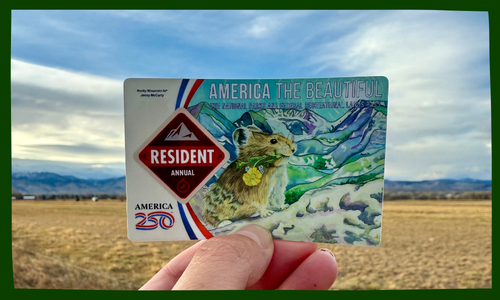
So Jenny is the artist behind the viral sticker that was created to go over the 2026 National Park Pass. And, you came up with this idea, it took off. I’ve seen you in media all over, and your art is incredible. You’ve created this solution and given people hope for their National Park adventures in 2026. How did this come about?
Jenny McCarty:
That’s a great question. And I have to say it didn’t happen in a vacuum. It’s not just my idea. It was. Listening very closely to my community who have very similar values to me and responding to a need, a desire in that community. So I think like many people, when the new 2026 past design was released, I was disappointed, fired up, upset. You can come up with all sorts of emotion words. Yeah. I just make a long list and I made a joke on my socials with a little round pica sticker that I include as a little extra thank you in some orders. I was like,”good thing I’ve got this adorable pica to put on the front of my pass” and people loved the idea. I got so many. Comments. So many dms saying, can, guests can, how do I get one? Can you please make real stickers? And so I got thinking about it, that actually I could do that and it would actually be pretty straightforward. And so I had three National Park paintings that I’d already created, Rocky Mountain National Park, Grand Tetons, and Denali. And I asked my community, okay, which design would you prefer? And they said all of them. So gotta give the people what they want. And in hindsight, maybe that wasn’t the easiest decision to make now that we’re fulfilling thousands of stickers. But we released all three for the resident design and for those who don’t know. The National Park Pass this year clearly demarcates, whether someone’s a US resident or a non-resident. And so we just came out with the resident pass because it had, for those who don’t know, portraits of George Washington and the current president on the front of the pass. So released all three designs for the resident pass. And then we had military and seniors who are reaching out and said, we want one too. So then we released all three designs for military and seniors, and now we’re running with nine different sticker design.
Missy Rentz:
And I just wanna go back and and talk about historically, and I think it’s by law, How are the designs for the park passes usually decided?
Jenny McCarty:
It is written into the rules of the parks pass that the design is selected by public vote on a photo competition. So photographers submit their photos of the National Park selected for that year. In 2026, it was supposed to be Glacier National Park. The winning design gets to be on the front of the Parks Pass. So not only was the 2026 design released for residents going against those rules, and there’s actually a case right now being brought by the Center for Biological Diversity against the Department of the Interior for breaking these rules. Not only was it going against those rules, but it also was in my opinion, a slight to art and artists and for the people that submit photos every year who find it a fun competition or even a part of their livelihood, it was quite a slight to the arts community.
Missy Rentz:
That is such a good point. Yeah. And I think it’s become, if you’re a park goer, I, for me at least, I think a lot of people, like it’s become a collector’s item. I love getting it every year, and I use it as Christmas ornaments
Jenny McCarty:
Although that’s a great,
Missy Rentz:
the year. Yeah. And so it’s like I, I want the art, I want the beautiful imagery. And sometimes I’ve been to that park and sometimes it makes it higher on my bucket list when I see it there.
Jenny McCarty:
Agreed. I think that it’s an educational tool, what you might be able to see at that park. I agree that it’s a collector’s item, like we still have ours, but they all live in a pile in our car. I’m, I like your idea of turning them into Christmas tree ornaments so much better. We’ll have to steal that from you, if that’s
Missy Rentz:
Sure, you can have it.
Jenny McCarty:
Awesome. Thank you.
Missy Rentz:
Okay, so you are I so they came out with this, was it, I think it was like late November. So they came out with this and announced it and you immediately,’cause it was a huge uproar. Not only that. Okay. So they announced that, and they announced that they were removing Martin Luther King and Juneteenth as free park days and instead putting flag day, our current president’s birthday, as a free day. So there was an uproar, huge uproar in the park community. So you presented this sticker solution to go on the face, to stick on the face of the card. But then shortly after that. The administration started to come up with these new rules and said, your park pass isn’t gonna be valid if you have a sticker,
Jenny McCarty:
Yes, that’s correct.
Missy Rentz:
So then you had to pivot.
Jenny McCarty:
We actually anticipated that they might say that. So yeah, on the Parks Pass, if you actually look in small lettering, it says something like, any alteration of this pass might void the pass. And we knew that previous guidance it. More had to do with the back of the past where the signature and the expiration date are. Those are the important details. Historically, rangers have actually enjoyed seeing stickers on the front. People collect stickers from the different parks that they visit all year long, or, just making it a little personalized. So stickers, historically, had never been a problem. Knowing this administration, we knew that might change. So we encourage people from the get go that there are few different ways that you could choose to adhere a sticker to the front of your pass, either directly on the pass or the sticker company that we worked with. They perforate the back in a way that you. Lift up the sticker to show the diamond underneath that says whether you’re a resident or non-resident. So still proving that it’s a valid pass underneath and your citizenship status. And then the third option was mounting the sticker on a clear sleeve and putting your pass in the sleeve so you could easily pull it out to show that it hasn’t been altered in any way. Since then, we have heard from our community that they would like just a direct mounted option that they could just buy so they don’t have to buy the sleeve and buy the sticker separately, that they can just get it all in one package. And while I love the idea, I am an artist and I have a full-time job also happening in the background, and so I, I don’t have the time to just mount stickers to clear card sleeves. You’re actually the first to hear that we’re actually working on a potential collaboration with another artist who’s already mounting art to sleeves, and she might be taking on that option. So it’s not official yet, but we might be releasing already marked sleeves for people to get. Yeah, you heard it first here.
Missy Rentz:
Yay. Congratulations.
Jenny McCarty:
Thank you.
Missy Rentz:
Where can we get a sticker?
Jenny McCarty:
You can get a sticker on my website www.thesageleafstudio.com. I am also on socials. It’s easy to find links there as well Sage Leaf Studio or Jenny McCarty art.
Missy Rentz:
I will, and I’ll put, I’ll post links in the episode page on the website as well as tag you in all of us. So that people can find you when they listen.
Jenny McCarty:
That would be great. Thank you so much.
Missy Rentz:
Jenny, what other challenges might people have when they go to a park and they do have the sticker, and these rules are or aren’t in place. We don’t know.
Jenny McCarty:
Yeah, that’s a really good question. And right now our guidance and it goes out with every sticker order, is to make sure you understand the rules and regulations that the park Rangers are dealing with and it might mean that you should be mounting it on a clear card sleeve so that it doesn’t alter your pass in any way, but just know the risks before you mount a sticker directly to your parks pass. Some rangers have received guidance that it’ll invalidate the pass, but the guidance is also that it is up to the Ranger’s discretion how they want to handle any kind of alterations to passes. So just keep in mind that. They can choose to void your pass and charge you for a day pass, or they might let you through. So before mounting anything to the front of your pass, ask the first Ranger you talk to and make a decision from there. That’s what we recommend. And the most important part too, I think, to remind people is that. The park ranger in the booth is your friend. They don’t like these changes to rules and regulations more than you do, and so please just be kind to them, be respectful, recognize that they are also dealing with the non-resident changes now too. So they’re dealing with also a lot of tourists coming in that are non-English speaking and having to deal with all these fee changes and calculating. Who’s in a car, so they’re probably having a more frustrating day than you, even if you’ve sat in the car for hours trying to get into the park. So just be kind, be respectful, please. Just be kind. You’re park rangers?
Missy Rentz:
Yeah. We need to show them a lot of love as we’re going through there.’cause they’re going through the ringer.
Jenny McCarty:
Yes. And they’re here for us Park rangers. Don’t get into this job to be rich.
Missy Rentz:
No, definitely not. Definitely not. Okay. So I also wanna chat a little bit about. Process.’cause I think for a lot of people learning about the park passes and how the art gets on them, this is a real kind of slap in the face to the arts community who who likes to go take these amazing photos and enter these contests to, to be on the park pass.
Jenny McCarty:
You’re right, I, and I’m actually interested in talking with any photographers out there who entered the 2026 competition or who may be thinking about entering a future competition. I am really interested in understanding their perspective, their opinion, and. Those artists who are directly impacted this year by this. So if anybody is interested in having a chat, please don’t hesitate to reach out to me over email or DM and Instagram i’d. I’d love to talk with you.
Missy Rentz:
I just, I have so many questions that are coming up for me. Okay. But first I wanna say, and this is a fundraiser, not only is it, are you an artist and this fulfillment has become come fantastically labor intensive, but you are donating 100% of the proceeds to National Park nonprofits. And there’s not money in it for the manpower, but what organizations are you all supporting?
Jenny McCarty:
We’re really. Excited and proud about the donation we’ve been able to make so far. So just in the month of December we, like you said, we donate 100% of proceeds for our stickers and we donated$16,000 at the end of December to the National Park Conservation Association, which is awesome. They are the nonprofit that’s preferred by most park rangers that we talk to. They do great work. So we are listening to our community about where they wanna see those dollars dedicated. And then in the month of January, we’re on track to do not quite as much, but a very big contribution. And it’ll likely go to the Center of Biological Diversity, who’s leading the charge against the Department of the Interior for the 2026 design?
Missy Rentz:
Fantastic. Oh, it’s so exciting, and I think people love to know that not only are they. Protesting by putting a sticker on, but they’re protesting by donating to these organizations who are doing a lot of work on our behalf to fight for our public lands.
Jenny McCarty:
Definitely. I think honestly that was one of the most important things that helped our stickers go viral in the first place is people realized that and they felt in their heart that this was more of a movement and a resistance and something that they could do in peaceful protest rather than supporting some revenue generating machine or profiting. Person, and I understand we’re a small business, we’re, I’m an artist. People love supporting artists, but I do think that at the end of the day, it is surprising to people that someone would don donate 100% of proceeds for something they’ve created and. At the end of the day for me personally and for my family, it is so much more important to us to support National Parks and something that is so deeply ingrained in our family history than to keep anything for ourselves. It just, it didn’t feel right, even, I don’t know how to else, to explain it. It, I. The whole point was to support our National Parks and giving a hundred percent felt right on top of that, I also don’t wanna diminish the volunteer hours that have been contributed. We have had four packing parties where we have anywhere from six to eight people dedicating two to four hours of their Sundays here. For the last four weekends, and it’s gotta be in the hundreds of hours at this point that volunteers, some of which we don’t know before they come. They’re just strangers that reach out and say, Hey, I wanna help. And these volunteers come and it creates such a sense of community. And I think people who come in feeling. Dismay, find hope like they’re touching envelopes that are going all over the country to people that value and love the same things that they do. And we’ve watched these people leave with so much joy and hope, especially’cause they’re connecting with other people at a our kitchen table that love the same things.
Missy Rentz:
I
Jenny McCarty:
Yeah, it’s so fun. And it’s been great meeting people and then now. They have felt empowered to go join other movements that maybe that they were uncomfortable about joining before. One of the sentiments that we’ve heard over and over again from people is they felt nervous to protest out in person. They’re not necessarily comfortable with big groups or loud noises or those kinds of things, and this felt like a comfortable, peaceful way to protest. And so after they’ve had this introductory experience, they feel empowered to go find somewhere else to spend more time.
Missy Rentz:
that’s beautiful. This podcast is really geared towards teaching people why our parks are here and how to use them, and I think. In this time we’ve also, we collectively, not just the podcast, have to teach people how to protest because for many decades we have not had to do this. And now it does take a collective effort. And just in the past couple of weeks, I’ve had several people say, I feel like I’m not doing anything and I think it’s time for me to do something. And you have demonstrated no. Through your art for sure, and then now through this story that one person can make a big difference in a movement.
Jenny McCarty:
hugely so. and I. I hope if anybody takes anything away from my message on this podcast in news articles, anywhere else. You every person has skills and gifts and talents that even if they’re dedicating a little bit of that energy and their time towards good right now, I think it collectively will go a very long way. So I challenge people to use their skills, their gifts, their talents, and figure out how they can leverage those for good and joy and love right now.
Missy Rentz:
Yeah. I love that. So you, I just, I love reading about your background. I feel like I know so much more about you.
Jenny McCarty:
Oh, thank
Missy Rentz:
You are a biologist. Yes. And a stream ecologist is I, am I, do I have that right?
Jenny McCarty:
Yep. Yep.
Missy Rentz:
And so those are not. Certainly those are things that connect to parks but you don’t necessarily think about art and artists being biologists. Can you share a little bit about your journey and your passions and how they all collided into parks, nature Art.
Jenny McCarty:
Definitely I honestly think most scientists have some sort of artistic element to them. Most scientists I meet, they. They make music on the side or they have a artistic, like visual artistic outlet, or they’re writers. I think that science and the creative mind actually fit very well together. But like most people in that realm, when I was a kid, I loved the arts and in many ways I was educated away from the arts. I also loved science. I’m very lucky that I had phenomenal science teachers and art teachers that. Supported my passions both ways. But I was told that art was not a good way to make a living and I was just as passionate about science. So I went that direction professionally and in many ways I’m glad that I did because having such intensive science background with a master’s in stream ecology, it helped to inform how I make art now. So in my thirties, like a lot of people I had developed a career and I looked around with and was like. Wait, what do I do for fun again? And so I picked up a paintbrush again. I definitely felt like I came back to art in my thirties. And was able to draw on my science background to paint the things that I wanna paint, and also paint places that I have had experiences in Denali. For instance, I was doing field work up there for my career, and I got to backpack through Denali several times, and that’s where the background picture from that painting came from was a trip with my dad and my brother when they came up to visit me. But similarly, my ecology background, the materials I choose are eco-friendly because I really care about my impact and my footprint on the planet and in my paintings for those who want to go look at them, there are lots of hidden elements in them, and the goal there is to remind people that. It’s not just one animal in the foreground. Animals are connected to entire ecosystems and other species that all interact with each other in the background too.
Missy Rentz:
I’m gonna have to go look’cause I’ve spent some time. Exploring them and trying to put myself in those moments because for me, nature is that, that reconnection with life and I think your paintings put me back into my childhood love of being in nature, which is really special. And that’s a gift that you give to us through your art to, to be able to do that. So thank you for that.
Jenny McCarty:
Thank you. I’m glad to hear that that’s the goal is to remind people of the joy and the wonder found out there.
Missy Rentz:
Yeah. And I think that something that you said really sparked an interest of you were trained out of art. Was that the way you
Jenny McCarty:
Yeah. Educated out of art.
Missy Rentz:
out of art and I was just having a conversation with a ranger just the other day about how in our school systems we are removing. Art and music and play and nature. And yet in our parks, when you’re out in a park, you, you gain independence and you gain creativity and you gain wonder, and you gain all these things that we are losing in our education systems and in so many ways. Being able to connect and, draw things with berries and I, it’s just really amazing beyond the great hiking trails or the great, kayaking and camping experiences, what our parks are giving to us.
Jenny McCarty:
Yes, I would agree. It’s a good way to remind people that there’s more than just a computer screen and all the things that they’re teaching us how to do on computer screens.
Missy Rentz:
Yeah, totally. Okay. So I art, I wanna go back to art art and movements specifically on what I think it’s a powerful, art can be a powerful statement in a movement. And one of the things the parks have, a movement of promoting the parks through this photography, but the censorship. That’s happening is impactful to the art community and the artists that are, I guess I, I would guess the art original artist was chosen for this. And who knows what happens in the future. But to you, how does art play a role in movements?
Jenny McCarty:
Ooh, that is a good question. I think. Art is incredibly important in movements. Artists see the world in different ways, how it is, how it could be. Art communities also often are mixing pots of lots of different ideas, backgrounds, people from very different walks of life with unique views that don’t necessarily trend with the normal. So it’s. Pushing cultural boundaries and opening up. Views on what could be. But also highlighting cultural weaknesses too and injustices that are happening. And at the end of the day, depending on what art you’re working with it impacts people in different ways. My medium is visual and there are a lot of visual people out there, and so being able to see something causes a feeling in them. For some people, auditory is so important, so creating. Music, thinking about artists that were really big in the sixties and seventies and helped push movements that were happening then with their lyrics for it. It in Ingrains in the entire culture of a country, a desire for change. Writing is incredibly important. I’m so grateful for all the reporters that have given me their time and reached out about the story, for instance, and used their beautiful writing skills to continue to spread the word and educate people. That’s an art in itself too. I think there’s so many people with different. Creative outlets, dance, acting it all plays into opening our minds to what could be.
Missy Rentz:
I love that. That’s really beautiful.
Jenny McCarty:
Thank you.
Missy Rentz:
What is next for Sage Leaf Studio and for you, Jenny?
Jenny McCarty:
Woo. I am 100% transparency. Looking forward to. Handing off sticker fulfillment to someone else. We are partnering with a retired park ranger in California who does sticker fulfillment now. And so he’s gonna take that on so we can get our weekends back and I can get back to painting. My next painting is gonna be of Yosemite National Park, so I’m really excited to work on that one. I have a lot of people that have reached out asking for a painting of Yosemite.
Missy Rentz:
I love it. That’s one of my favorites, so I can’t wait for that one. Yeah. I, but you know what, every episode I do, I go, oh, that’s my favorite.
Jenny McCarty:
Do you have a favorite park?
Missy Rentz:
My favorite big one is Yosemite, and I went to Yosemite when it, like before before I got busy. I don’t, I’m not good with big crowds and so it was just this spiritual, very quiet, not a lot of people moment
Jenny McCarty:
that there weren’t a lot of people
Missy Rentz:
Oh, it was unbelievable. Oh my gosh. It was unbelievable. And so that Yosemite and just Yosemite and its history and I went when I was like, had gotten so into the parks and so I just felt like this connection to the earth, which was really beautiful. And. I love the little ones. I love them. And I think that has was a spark to why I wanted to share the stories of the parks.’cause I think people think of, Yellowstone and Yosemite and the Grand Canyon when they think of the parks. But there are 430 plus and I love Organ Pipe Cactus, right on the the border of Arizona and Mexico. I love Francis Perkins in Maine, so
Jenny McCarty:
have heard of that
Missy Rentz:
oh my gosh, there’s some of the coolest, wonderful monuments in battlefields. And I do love a battlefield. I live in Virginia, so I’m just surrounded by battlefields and there’s something about hiking through a battlefield and you learn about the history and then you see, the terrain and you think about these young, very young men using just a small hill to s protect them. I don’t know, it’s just,
Jenny McCarty:
It is wild to go back in time. My husband’s also from Virginia and we visited, I visited Jamestown for the first time just a few years ago, and it was mind blowing to think about. The conditions of the planet and what people, how people lived back then. It was really interesting.
Missy Rentz:
Yeah. So I have a lot of little ones based off of that, but I think that the I’m gonna call them little parks. I do think that maybe there are groups that call’em the, them little parks, but those are the most surprising to me because they don’t get the attention. And they are gems. Oh, they’re such gems. It’s, they’re beautiful. Do you have a favorite?
Jenny McCarty:
Favorite National Park? I don’t, honestly, I have been, I’m very lucky to have been to many parks west of the Rocky Mountains, and they all have special places in my heart for different reasons. Yeah, it’d be hard to choose. Yosemite was my grandparents’ favorite park. I have very fond memories there. Rocky Mountain is the closest park to me now, which is an awesome park. I did my grad research on the Gallatin right outside of Yosemite or Yellowstone National Park and family lore is that I was named after Jenny Lake in Grand Teton. So we’ve been to lots of National Parks and I love them all for different reasons.
Missy Rentz:
I guess it is like asking you to pick a favorite child
Jenny McCarty:
yeah.
Missy Rentz:
And it just depends. Everyone’s a different experience.
Jenny McCarty:
Yes. Yeah.
Missy Rentz:
I’m very excited for your work and what’s to come and I’m very grateful to you for this form of protest that you have created.’cause you’ve really, like I said at the beginning, you’ve given people hope
Jenny McCarty:
thank you. That means a lot.
Missy Rentz:
art For sure. We end every episode with a speed round of questions.
Jenny McCarty:
Okay. Fun.
Missy Rentz:
with what first comes to mind. What is your earliest park memory?
Jenny McCarty:
My earliest park memory is at Great Sand Dunes National Park. My family goes there most years in the spring when sometimes it snows too. So it’s not really balmy. But I re I must have been nine or 10 maybe, and we were there with several other families and we’re all sitting around the campfire and the kids are. Playing and the parents are having a good old time. And it just was a place where we’d all get together and it felt like there were no other cares in the world. Everyone seemed to be having a great time.
Missy Rentz:
And what made you love the parks?
Jenny McCarty:
I, for me, I think for a lot of people, it’s a connection to nature. For me, it’s family memories. I. I definitely feel in my family that National Parks are a legacy. My grandparents took my dad and his five siblings to Yosemite. Multiple times in a little Shasta trailer. And then my dad in his younger years, spent a lot of time through Wyoming and Montana and the West, exploring and working odd jobs, being a ski bum. And then he instilled that love of National Parks and us. And so my brothers and I were very lucky to visit National Parks with him all over. The Continental West and now today we still travel to National Parks. My, my dad books, us trips and we go, and now my siblings have kids and so the grandkids are there too. And it’s just, it’s a legacy thing. Very strong family bonding time and memories there.
Missy Rentz:
What’s your favorite thing to do in a park?
Jenny McCarty:
Oh my gosh, that’s a hard question. Do you have an answer to that question?
Missy Rentz:
I do. I love to hike and I love to just sit and watch people and things.
Jenny McCarty:
it is great people watching. I know people like to get into nature to get away from people, but if you’re in a packed campground, it’s great people watching.
Missy Rentz:
and I’m a very like I, in most things in life, I’m like the I sometimes I say I’m like the wimpy one, but I’m like the how do I I’m the slow one. So I like a slow hike. I like a slow sit and watch people. I like a slow anything. But I love to watch and just see how people are experiencing the park.
Jenny McCarty:
Yeah I would agree. In a weird way, a lot of park time is people, time for me, usually when I’m going to parks, it’s with other people. When I’m going out on a hike by myself, surprisingly, it’s not usually to a National Park. So it’s quality people time.
Missy Rentz:
Yeah. I’m with you on that. What park have you yet to visit, but it’s on your bucket list and why?
Jenny McCarty:
Can I answer too?
Missy Rentz:
Of course.
Jenny McCarty:
White Sands National Park because it’s a. Close one that we could get to and it looks beautiful and like it belongs on another planet and gates of the Arctic because that would be such a high lofty goal of a National Park to get to. It is way up there. What about you?
Missy Rentz:
I am probably the, just, I’ll put all the Alaska National Parks in one bucket.’cause I feel like when I do it and I’m gonna manifest that it is a, when I do it.
Jenny McCarty:
I love that for you.
Missy Rentz:
be all of them together.’cause I think that’s so special.
Jenny McCarty:
Yeah.
Missy Rentz:
Yeah. What are three must-haves you pack for a park visit?
Jenny McCarty:
I am not gonna say the normal ones because I’m sure everybody says hiking boots, backpack, et cetera. So I’m gonna say my camera. I have a travel paint kit, which I love to bring, and a good sun hat.
Missy Rentz:
What’s your favorite campfire activity?
Jenny McCarty:
S’mores eating well, mostly. Yeah, definitely. Eating s’mores
Missy Rentz:
And are you an a tent, camper or cabin
Jenny McCarty:
or tent campers.
Missy Rentz:
and the cat is coming up over your head and that’s
Jenny McCarty:
I know he, I’m sorry if you could hear him banging at the door earlier, but he wanted to get in.
Missy Rentz:
No. Oh, he is just crawling up your back. That’s hilarious. Okay. Are you, when you hike, are you going with or without trekking poles?
Jenny McCarty:
Without trucking poles. What about you? Are you a trucking pole?
Missy Rentz:
I’m a I love a trekking pole, but it depends on the terrain, I have several experiences, certainly if it’s hilly, the coming down, particularly as your knees age, the coming down is harder and it’s nice to have the trekking poles, but they’re also really nice if you’re in a terrain and you. Poke and see particularly your, I know you’re Colorado and I spend a lot of time in Montana on a winter hike, they’re awfully nice to make sure you’re not going six feet down.
Jenny McCarty:
Yeah, that’s a good point.
Missy Rentz:
Yeah. Yeah. I like’em. Okay. Yes, totally. Okay. What is your favorite animal sighting that you have?
Jenny McCarty:
Wow. One comes to mind very recently. I love seeing Pika. Honestly. They’re just the cutest little things and you have to earn seeing Pika. You gotta get up there to see them. But we were in Rocky Mountain National Park last fall with Friends for the Elk Rut, and we went on a beautiful day hike. It was gorgeous. People were in tank tops and shorts and there was a bull moose. And I have never seen a bull moose. Call, mating call and it’s like very deep guttural, low tone, and that was so cool to see for the first time.
Missy Rentz:
Oh, that’s really cool. What’s your favorite sound in a park?
Jenny McCarty:
Can I say PICA again?
Missy Rentz:
Yes.
Jenny McCarty:
Yeah. The pica squeak is so cute. What about you? What’s your
Missy Rentz:
I love how silent it is. I just think it’s the most unique thing, like when you’re sitting in silence, the things you do hear, like the, like the kind of the cracking of a tree swaying in the breeze, or, the ruffling of a leaf from far away. And one time I was camping in the boundary waters and I was in my tent and it was very quiet. And then these chipmunks started chasing each other around the tent. So I think it’s very quiet. Yet there’s these other things that you wouldn’t hear on a
Jenny McCarty:
life is still happening around
Missy Rentz:
is happening. Yeah.
Jenny McCarty:
yeah, that’s poetic. I love that.
Missy Rentz:
Yeah. And what is the greatest gift that the parks give to us?
Jenny McCarty:
I really think that the parks are an egalitarian place. Entry fees are so low. They were created. For all Americans, no matter your background, no matter your economic status, your race, all those things don’t matter in a National Park. They are for all of us, and I think that is the greatest park about National Parks and everybody loves them. I’ve had conversations with people from all types of backgrounds that have wonderful memories of National Parks, and it’s just a great way for all of us to connect as humans that enjoy this planet.
Missy Rentz:
Yeah. Beautiful. Jenny, thank you. Thank you for being here. Thank you for sharing your talents and gifts with us. Thank you for showing us how to protest in a unique and artistic way, and maybe most of all, thank you for letting us have a beautiful scene on our park passes in 2026.
Jenny McCarty:
Oh, you’re welcome. Thank you Missy, so much for having me on. I really appreciate it.
Missy Rentz:
Absolutely. Thanks for listening to this episode. Until next time, we’ll see you in the parks.
Thanks for listening. If you enjoyed today’s episode, please be sure to like and share on your favorite podcast platform. Music for the parks podcast is performed and produced by Porter Hardy. For more information, please follow us at The Parks Podcast, or visit our website at TheParksPodcast.com.