
You can drive through Cuyahoga Valley National Park and not even know you’re in it.
That’s not a design flaw — it’s the whole point. Nestled between Cleveland and Akron, this 33,000-acre park weaves through 15 cities, villages, and townships. People commute through it. Farms lease land inside it. The Cleveland Orchestra plays its summer home there. You can kayak the river that used to be too toxic to touch, pick blueberries from a working farm, ride a scenic railroad through the valley, and stop for wine at a vineyard all within the same park.
Pamela Barnes — Community Engagement Supervisor at Cuyahoga Valley National Park — joins me to talk about the park’s remarkable 50-year history, its conservation work, and why this might be the most surprising national park in America.
A note from Missy: I’ve been to Cuyahoga Valley a couple of times and I keep coming back because there’s always something new to find. The story of the Cuyahoga River — the river that caught fire and became the catalyst for the American environmental movement — is one of the most important environmental stories in the country. And the bald eagles? Now nesting in the park. The river is clean. It is a comeback story and I love it.
Episode Guest
Pamela Barnes, Community Engagement Supervisor
Cuyahoga Valley National Park
Show Notes & Links
- Cuyahoga Valley National Park: nps.gov/cuva
- Conservancy for Cuyahoga Valley National Park: conservancyforcvnp.org — volunteer opportunities, concerts, programs
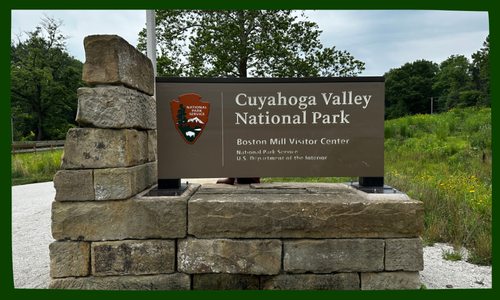
- Boston Mill Visitor Center — start here; rangers will build your itinerary
- Cuyahoga Valley Scenic Railroad — use as a shuttle for bikes and kayaks
- Ohio and Erie Canal Towpath Trail — nearly 100 miles, extends to downtown Cleveland
- Working farms: 8 farms on 60-year leases; CSA, blueberry picking, Sarah’s Vineyard wine
- Blossom Music Center — summer home of the Cleveland Orchestra; On the River free concert series
- Volunteer: 4,642 volunteers gave 109,000+ hours in 2024; contact park volunteer office
Episode Transcript
Cuyahoga Valley National Park
The Parks Podcast, Episode 66 | Pamela Barnes, Community Engagement Supervisor, Cuyahoga Valley National Park
Welcome and Park Stats
Missy Rentz: Nestled between two US cities, you can weave in and out of this park on your daily commute or make it a destination for your next vacation. Join me as we explore Cuyahoga Valley National Park. I’m your host, Missy Rentz, and this is The Parks Podcast.
Missy: In this episode, I am so excited to chat with Pamela Barnes, who is the Community Engagement Supervisor at Cuyahoga Valley National Park. Pamela, welcome to The Parks Podcast.
Pamela Barnes: Thank you so much. I’m really excited to talk with you.
Missy: I am so excited about this park. It’s so unique. We start each episode with some quick stats for everybody, so I’m gonna run through those. The park is located in Cuyahoga Valley, in the Cleveland/Akron area. It’s the 56th National Park. It was created on December 27th, 1974 — it was established as Cuyahoga Valley National Recreation Area, and then in 2000 it became a national park. At the time, Gerald Ford was President of the United States. The park is 33,000 acres. The highest elevation is 1,180 feet at Brush Road and the lowest elevation is 590 feet at the Cuyahoga River. In 2024, there were 2,913,454 visitors in the park. Some fun facts: there are 125 miles of hiking trails, more than 44 miles of horse trails, and 10 miles of mountain bike trails. It’s home to the tallest waterfall in Ohio — Brandywine Falls. It has a diverse ecosystem that includes forest, wetland, grassland, and river. There are over 1,145 plant species, and this park is 20 miles long and six miles wide. It encompasses 15 cities, villages, and townships; two metropolitan park districts; and eight working farms. Pamela, I think this is one of the most unique parks. There’s nothing like Cuyahoga Valley.
Pamela: You are so right. And if you think of something that you like to do, you’ll probably find it here. It’s that diverse.
Why Cuyahoga Valley Is Part of the National Park Service
Missy: We are talking at the end of the 50th anniversary of the park — you’ve had a huge celebration for the past year and are starting to wrap it up. It was a national recreation area and now it’s a national park. Why is it important that the park is part of the National Park Service?
Pamela: If you think about it, what’s the criteria to become part of the National Parks — it has to be somehow significant nationally. And so there were a lot of things where people went back and forth saying, should this be part of the National Park? Should it be a state park? Is it a local park? If you look at it, it’s the Cuyahoga River in its watershed — the river that’s known for catching on fire. It’s not the only river in America that caught on fire, but this one really became the poster child for the American environmental movement. Now the fire didn’t happen out in Cuyahoga Valley — it happened in downtown Cleveland — but about one quarter of the length of that river goes through this park. So it’s a central feature. And so it was set aside to protect the Cuyahoga River Valley.
Pamela: Also, the way it’s so close to two metropolitan areas — it’s been called the Green Shrouded Miracle, this valley that’s in between these two cities and so accessible to several million people. Part of our purpose statement is to provide the necessary recreational open space for the urban environment. During the Nixon administration, they came up with the idea of parks to the people — creating national parks that are close to where the people are, like a gateway to beginning to visit National Parks. It’s a half hour, 20 minutes down the road for many of the people that live locally.
Pamela: And then also the ecological significance of where we sit — on the edge of the Appalachian Plateau and the Great Plains, with the Great Lakes watershed to the north and the Mississippi Watershed to the south. That gives this intersection of all kinds of different ecosystems and species that either live here or make their way through. And finally, it’s the history of the people — the Ohio and Erie Canal, the CCC — there are remnants of that human history as well, going all the way back to when people started living here in the valley. So it’s a lot.
Missy: It’s a whole lot and I love it because it’s got the nature and conservation and the activity and the history — the list goes on and on. It’s just got something for everybody.
Pamela: That was our tagline at one point — something for everyone. And you say it’s like a tapestry. So it’s what it is.
How the Park Grew — and Tensions Along the Way
Missy: Most parks it’s an evolution. That was one of the things that surprised me when I first started diving into my love of parks — they’re often created by community groups, and then the efforts grow and grow. And this park is no different. But it is unique in how it grew because it’s within the community and there are partnerships with Metro Parks and others. It’s fascinating how this park grew.
Pamela: It really is. And there’s also a tension between — there were local people who really saw the value of protecting the valley, where it was just gonna become part of urban sprawl if somebody didn’t do something to protect it. But there was also the early years of land acquisition, with the federal government buying property and making it part of a national park. So over the past 50 years we’ve been working to have great relationships with our partners — especially the Village of Peninsula, which was actually hit hardest by the park acquisition years. They have now designated themselves as a gateway community and are seeing the value of the tourism the park brings.
Missy: And it did start — it was Native Americans that forfeited their land. And in order to create the park, it feels like this area was the escape from the city to recreate. That’s what the 1800s seems to be, that was the purpose you see in so many parks just outside the city.
Pamela: Absolutely. And at one time it was the great Western frontier — there was a time where the Cuyahoga River was the western boundary of the United States. So that’s part of our history too.
Missy: Tell me about Camp Mueller — it was a kid’s camp.
Pamela: Yes. So there’s a great history of African American recreation in the valley. Camp Mueller was originally a place for African American kids from Cleveland to come out and have a camp experience — and to learn to swim when they weren’t allowed in the public pools and swimming areas in Cleveland. It was started by the Phyllis Wheatley Association, which was providing services for Black Americans who were migrating north from the south during the Great Migration.
Missy: And at a time when to have a place to go where you could learn to swim and recreate and learn how to use the outdoors — that was really valuable and unique.
Pamela: Yeah. And that’s still what we’re about — a place where you can learn the skills to take a shorter hike, where the cost of getting lost or making a mistake is very low because you’re gonna come to a road in a very short time. So it’s not true wilderness. You can start to feel more comfortable in an outdoor setting. You can join activities with other people if you don’t feel comfortable going out by yourself. And you can learn skills — like, you can borrow some snowshoes and try that out without having to buy them. You can just try it for free with us.
Conservation — The River, Reforestation, and Invasive Species
Missy: Conservation is really big here and I love it. The conservation of the river and the fire and how important that was — and now it’s pretty clean and a lot has been done in the past 50 years. But what are some of the projects that you all are working on in the park?
Pamela: One of the biggest things is a rather large reforestation project. We’ve planted thousands of trees to restore some former mine sites — extraction was one of the industries here in the valley — and we’re trying to replant trees in places where historically they were eastern deciduous forest. So there’s a big effort to remove non-native plants and replace them with native trees. If you drive through the valley, you might see little plantations of little trees with some protection around them to keep the white-tailed deer from eating them all.
Pamela: We’ve also been restoring the river banks. One of the challenges is having infrastructure right next to a river that wants to be a river. We’ve got the Cuyahoga Valley Scenic Railroad — the tracks are pretty close to the river. The Ohio and Erie Canal Towpath Trail is very close to the river. So we have been fortunate to receive money from the Great American Outdoors Act to do some major riverbank stabilization, to keep those two beloved experiences available. They employed some really creative ways to do that. In the village of Peninsula, there’s a retaining wall to keep the river from taking out the railroad tracks. But in other areas, they really tried to use natural features to allow the river to be a river.
Missy: One of the things I think is so important — my mission is to talk to people who are curious but maybe haven’t started going to parks yet. And when you’re in a park and you see plastic fencing or a sign that work is being done for reforestation or whatever — it’s so important that you don’t go in those areas. You’re not going that far out of your way, and walking on these areas is harmful. It’s important that we’re paying attention and helping you do this amazing work of conservation.
Pamela: Yeah. Thanks for mentioning that. One of the things we’re really excited about is we were able to purchase the land of a former golf course. There are two streams on that property that have lost their connection to the Cuyahoga River — some of it has been culverted. Part of our long-term plan is to help those streams come back and to protect the species that are living there. They actually found some really cool cold water species. Just a little thing like stomping through the creek might be disrupting some of those species that we’re trying to protect. It’s all about numbers — I remember as a kid stomping through streams, but if you multiply that by 3 million people, that’s where you have to think about the impact.
Missy: And staying on the trail and just respecting — especially those areas where it’s very obvious there’s work being done. That reforestation takes a lot of time and a lot of energy and a lot of manpower. The other thing you mentioned was removing invasive species and bringing in native species. Why is that important?
Pamela: If we want to maintain the ecosystem that is here in northeast Ohio, we do need to think about what species have come here because of humans moving from place to place. The reason that we want to protect native species is that if a non-native species is brought in, it doesn’t have any natural predators. Nobody eats it because they don’t know what it is. And so it hasn’t had time to become part of the ecosystem. A lot of the non-native plants are a little more opportunistic — by creating so many seeds that it crowds out the others, or by greening up earlier in the spring and crowding out the native species.
Missy: Do invasive species come because somebody took a plant and planted it there? Do they come because a seed happened to be on my shoe?
Pamela: Yeah. The answer is yes. Some of them — like the multiflora rose — was brought from Europe by people who settled here because it makes a nice natural fence line. Sometimes we do things and we don’t know what the impact is going to be. I don’t want to place blame on anybody in the past for just living their life. So some of them were brought here on purpose, and some things just hitch a ride on people. We have a small cave in the park that we’ve closed because a fungus — whose spores get carried by people on your clothing and shoes — affects the native bats that live here. So we’ve got a big gate closing off the cave to protect the bats. Sometimes we do have to make decisions on what we give access to and what we don’t. Because it’s a dual mission of the whole National Park Service — protect and preserve, and yet provide for the enjoyment of the people. We have to do both of those things at the same time.
A Lived-In Valley — Community, Farms, Art, and Music
Missy: One of the things I think is so unique about Cuyahoga Valley is how it is part of the community. I mentioned the number of cities and towns and farms and whatnot. But you can be driving through the park and not even know you’re in a park.
Pamela: That’s one of the more confusing things. It’s not like you come up to the gate, you see the ranger at the gate, and boom, you’re in the park. When you’re traveling through the park, you’re going through residential areas and you might be thinking, wait a minute, am I still in the park? And you’ll see a Welcome to Cuyahoga Valley sign because you left the park and now you’re reentering it. There are so many ways to get through the park. A lot of people — their morning and evening commute is through the park, which is also pretty cool. So it’s a lived-in valley.
Missy: It is. And I have some friends in Cleveland and have spent time there. You all have a relationship with the Metroparks, which is this huge park system in Cleveland, and everything intersects to give accessibility to people through the bike trails and everything. It is a little confusing, but it’s also for the benefit of the users.
Pamela: Oh my gosh, yes. Our trails connect, and the river is a physical connection too. And just in the past few years, the idea of paddling on the Cuyahoga River — 50 years ago you never would’ve thought about paddling on the Cuyahoga River. It was don’t touch it, stay away. But now we’re encouraging people to paddle and we’re working with Metro Parks to provide that access.
Missy: It’s got an unfortunate reputation because of what happened so long ago — because it really is a beautiful area and clean and fresh and you’ve done a great job of reestablishing the nature in that region. The farms — can you tell me a little bit about them? It’s kind of cool that there’s a winery inside the park where you can buy wine grown there. They’re like real businesses.
Pamela: Yeah. So back in 1999, this started — and the idea was that historically this was a pastoral valley. There were subsistence farming, families who lived here in the valley and farmed. So the park owns all these properties, and there was this really unique idea: why don’t we fix up these properties and lease them out to farmers? It’s a competitive process — you have to write up your plan of how you’re going to farm sustainably, what your product is going to be, what your business plan is. And that’s how the farmers are chosen. They live there, they raise their kids there — they’re absolutely part of the fabric of the community. It’s a 60-year lease, so it’s a long-term commitment. We didn’t want people to be coming and going.
Pamela: And it’s been really wonderful. It’s such a cool thing to drive through and see. You can see signs like Greenfield Berry Farm — in the summer you can go and pick blueberries. The winery — Sarah’s Vineyard — is right across the road from Blossom Music Center, and they have really good food too. One of the other farms has a storefront right in town in the Village of Peninsula. You could get your Thanksgiving turkey, chicken, eggs, other kinds of produce from local roadside stands. And some of the farms do programming where you can get to know them and learn about the process — why did they become a farmer in the valley and what’s the value to the public? It’s a different way to connect to the land.
Missy: I’ll put a link in the episode page on TheParksPodcast.com so that if listeners want to learn more about the eight farms, they can do that. The other part of that — being within communities — is the art and music that you showcase in the park.
Pamela: So top of the list would be Blossom Music Center, which is the summer home to the Cleveland Orchestra. And as you visit some of the places in the valley, you might hear something coming from Blossom. Musicians who come there say, “I love coming here. It’s like coming to camp” — and it’s one of the most beautiful outdoor music venues. For our 50th anniversary, we had a very special performance there. And our partner, the Conservancy for Cuyahoga Valley National Park, has been putting together a really fantastic summer concert series called On the River. On a Sunday afternoon you can come — it’s totally free, it’s a big open field venue where you bring your lawn chairs and enjoy an outdoor concert. There are food trucks. They also have indoor concerts and lecture series. They do a program called Low Power Happy Hour — you can come and hear from a musician or somebody that does an interesting talk. They do National Park trivia, so you can sign up with a group to come to a trivia night. So if hiking maybe isn’t your thing, we have this whole slew of music and arts offerings.
Missy: One of my inspirations for starting this series is the value that parks bring to us — the physical, mental, emotional benefits. And I think sometimes when people think of a park, they think of rock climbing or extreme activities. But really sitting on a blanket and having a picnic, or meeting somebody and having a conversation on a bench — those are as valuable, maybe more valuable in certain ways, as extreme fitness. So parks are for everyone. Cuyahoga Valley is really for everyone.
Pamela: Yes. And I think of parks too as places where significant life events can happen. I hear so many people say, “I proposed to my wife at that location,” or “We got married there.” You can also have these very memorable life events in parks.
Missy: And I was having a conversation with somebody recently. They were doing a big event and lots of families came to the park and the parents were really concerned that the kids were gonna be bored. And the ranger said, “I promise you they’re gonna be just fine.” And they said, “Yes, but there’s no WiFi.” As soon as the kids were set free to play, their imaginations just opened up. It was just transformative — what their brains let them do once they got into the park.
Pamela: Oh my gosh, that’s such a good point. We’ve been having conversations about the importance of play in the development of young brains. And the answer to “there’s no WiFi” — I am like, exactly. There’s mud. There are wooded areas. One of our local Metro Parks has put in a kids’ natural play area at their nature center. So to encourage kids to be kids — and adults to be kids too — find that inner child in yourself. Unplug, recharge. That’s what you can do here.
Planning Your Visit
Missy: Let’s talk about planning a trip to Cuyahoga Valley National Park. What’s the first step you recommend?
Pamela: Look at our website. There’s a Plan Your Visit page on nps.gov — every park has one. Download the NPS app because the app can tell you what other parks are close by that you didn’t even know existed. And if you’re not that much of a planner — find out how to get to the park, go to the visitor center, go to Boston Mill Visitor Center. There are smiling rangers just waiting to help you plan your visit. They’ll ask you things like, what do you like to do? How long are you planning to be here? And they’ll help you plan an itinerary that matches what you like to do.
Missy: Yeah. They’re so informative. I was there on a busy summer weekend and I didn’t really want to be with the crowds, and they were able to say, if you do this, you’re not gonna be with the crowds. What kinds of activities can you do in Cuyahoga Valley?
Pamela: Of course you can hike. You can ride a bike, you can kayak on the river, you can ride a train. You can also use the train as a shuttle — put your bike or your kayak on the train in one direction and travel back to your car in the other direction. That’s a really cool, unique experience. If you bike on the Ohio and Erie Canal Towpath Trail, that trail is now almost 100 miles long — it extends well beyond the National Park to the south and all the way into downtown Cleveland. That is a way that you can ditch the car and travel through the valley.
Missy: It goes to New Philadelphia?
Pamela: Yes. So beyond the national park, there’s a national heritage area that encompasses that bigger area — that’s the Towpath Trail. And you can go on a driving tour — there’s a scenic byway that you can just drive and enjoy the valley.
Missy: I think you can go there for a long extended visit, but it’s also one of those parks where you could have an amazing time for a day, see a couple things, and then go back through another time when you’re in the area.
Pamela: Yeah. I’ve talked to people who stopped and said, “Hey, I saw the sign on the turnpike so I got off the highway. What’s here?” And so you can go hike the Ledges Trail — these spectacular rock formations — you can do a little bit of it or you can do the whole thing or you can connect to other trails. It’s something for all seasons too. In the fall you can see spectacular fall colors. In the winter you can enjoy a quieter experience — I love the quiet of a snow-covered trail. If there’s enough snow you can cross-country ski or snowshoe. And in the spring you can enjoy the wildflowers and birds and see everything come back to life.
Missy: Your comment on the seasons is something I think is really important. How do you approach planning a trip in different seasons?
Pamela: You have to really think about your clothing. Like many places, the weather may change quickly. Think about having a waterproof outer layer and layers that you can put on or take off depending on how the temperature changes. With winter hiking, you start out being overdressed — and then it’s dangerous if you work up a sweat and it’s really cold. So it’s good to have layers you can take off. A good pair of shoes or boots is really important because the trails can be super muddy. And watch out for poison ivy, and in some times of year you do need bug spray or a way to protect yourself from ticks — that’s a big concern.
The Conservancy and Volunteering
Missy: You have mentioned the Conservancy several times, and I know they were a really big part of the 50th celebration. Can you tell us a little bit about the conservancy and how people can support or get involved?
Pamela: The Conservancy was a group that actually predated the park. The Cuyahoga Valley Association started before we were even created as a national park. They’ve grown into this organization — the Conservancy for Cuyahoga Valley National Park. I like their tagline: we are for the park. As a nonprofit friends group, they do a lot of things to support us — financial help, expertise. They have a very large staff, almost as big as the park. And something else unique about this park: our volunteer program is run together with the conservancy. Joining and volunteering is one of the big ways to support the park — or go visit one of their stores in the park where a percentage of sales comes to the park. People can also join as a member of the nonprofit organization. It’s vital to the success of parks that people know what these friends groups do.
Missy: Yeah. And one of the things that blew my mind — in 2024 you had 4,642 volunteers that volunteered over 109,000 hours of work to the park. That’s a lot of work that has to be done in order to have these amazing parks.
Pamela: Yeah. And a lot of that is the removal of invasive plants and the tree planting. Even if you’re not local, there are drop-in opportunities advertised. If you follow us on social media, you can say, “I’m gonna be there on Thursday afternoon — there’s an invasive plant removal session.” You can go join in, or plant a tree and come back and visit your tree years later. There are ways for people to get involved for a couple of hours, or we have people that have given thousands of hours over the years — helping in the visitor center, talking to people, helping maintain the grounds, helping with programs. Any kind of job you can think of, we probably have a volunteer opportunity.
Lodging and Getting Around the Park
Missy: This is a park that doesn’t have camping or lodges within the park, but you are within communities and close to cities. How do you recommend people find lodging information if they’re staying overnight or a couple of days?
Pamela: I think one thing to do is to go to the convention and visitors bureau websites — like Destination Cleveland or Akron Summit Convention and Visitors Bureau — to find local lodging. Or there are a lot of Airbnb opportunities. It’s such a diverse community that all around us there are different types of lodging available.
Missy: And the other thing I wanted to ask — because it’s 20 miles long — how do you recommend somebody determine where in that 20 miles they may want to stay or enter the park?
Pamela: That’s a good question. So if you’re coming in through Cleveland Airport, the north end along Rockside Road has some great opportunities — a lot of people end up staying up there because they’re close to the airport. Down to the south, Akron and Cuyahoga Falls are good if you’re interested in things in the southern end or if you want to include a trip to Blossom Music Center. I would say look at what kinds of activities you might be interested in, or look at the communities that are closer to the center of the park. Boston Mill Visitor Center is smack in the middle. A lot of the hiking opportunities are in the south end, and then the connections to Cleveland Metro Parks are in the north. We have Canal Exploration Center — a place to learn about the history of the Ohio and Erie Canal — that’s up more toward the north end of the park.
Missy: The Plan Your Visit page is so amazing. It’ll say, “I’m here for a couple hours” or “I’m here for a day” — you all do such an amazing job of even online trying to steer people toward their areas of interest.
Speed Round
Earliest park memory?
Camping at Cuyahoga Valley as a young naturalist-in-training — being drawn to the natural world from a very early age.
What made you love the parks?
Being a naturalist and environmental educator — connecting people to place. The mission to share the natural world with others.
Favorite thing about Cuyahoga Valley National Park?
The diversity — the tapestry. If you think of something you like to do, you’ll probably find it here. And also the places where significant life events happen — proposals, weddings, memories made.
Favorite thing to do?
Explore the park with other people and find the unexpected.
Three must-haves for a park visit?
Camera. Good shoes or boots for the conditions. Layers.
Favorite campfire activity?
Sitting around and chatting, sharing family stories. “I love sitting around and talking about memories.”
Tent, camper, or cabin?
Cabin now — loved tenting in earlier years.
Hiking with or without trekking poles?
Definitely with.
Favorite trail snack?
An apple — always have one. “My kids joke that I’m driving the car eating an apple, I’m walking along eating an apple.”
Best animal sighting?
The first nesting pair of bald eagles at Cuyahoga Valley in 2007. “It was one of those moments where it’s historic. The hair on the back of your neck stands up. These eagles are here because they’re finding food in the Cuyahoga River — that is crazy. And now it’s become a commonplace thing to see a bald eagle here.”
Favorite sound in the park?
The wood thrush — a flute-like call deep in the wooded areas. “No matter what’s going on, it just makes me relax.”
Greatest gift the parks give to us?
“This lasting legacy — something that is going to be there in the future. Isn’t there something comforting in knowing that it’s going to be there for your great-grandchildren and theirs?”
Missy: Pamela, thank you so much for taking time to tell us the stories of Cuyahoga Valley National Park. I’ve got a permanent smile on my face hearing all of it. I really appreciate it. And I’m going to have to come back and say hi when I explore Cuyahoga Valley again.
Pamela: For sure. Come visit.
Missy: I absolutely will. Thanks for listening to this episode. Until next time — we’ll see you in the parks.
Music for The Parks Podcast is performed and produced by Porter Hardy. Follow us @TheParksPodcast or visit TheParksPodcast.com.