
Bryce Canyon is not a canyon. It’s a series of natural amphitheaters carved into the edge of a plateau — filled with the greatest concentration of hoodoos on Earth, capped by some of the darkest accessible night skies in the country, and sitting at the top of a geological staircase that holds 200 million years of Earth’s history. Peter Densmore, Visual Information Specialist at Bryce Canyon National Park, joins The Parks Podcast to explain what makes this place so otherworldly — and how to experience it in every season.
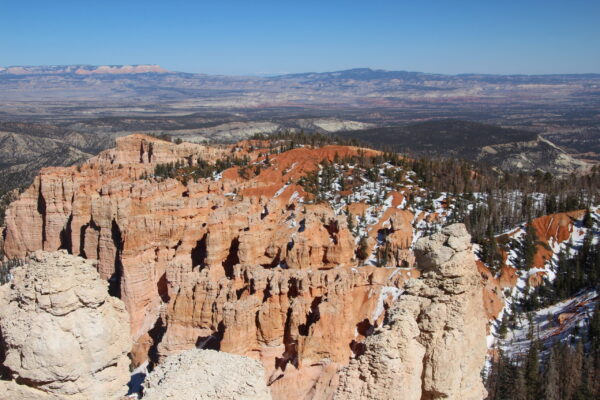
A note from Missy: I visited Bryce Canyon in winter during COVID. Access was limited, but I stood at the overlooks and soaked in the scenery — snow on the peaks of the hoodoos, views that seemed to go on forever. I pulled out a chair, made a peanut butter and jelly sandwich, and had a picnic at the rim. It was one of the most peaceful moments of my life.
Episode Guest
Peter Densmore, Visual Information Specialist
Bryce Canyon National Park
Park Stats
- Location: Paunsaugunt Plateau, southern Utah
- Designated: National Monument June 8, 1923; National Park September 15, 1928 (President Calvin Coolidge)
- Size: 35,835 acres
- Annual visitors: 2,354,660 (2022)
- Elevation: 8,000–9,100+ feet
- Trails: 78 miles
- Notable: Greatest concentration of hoodoos on Earth
- Night sky: International Dark Sky Park designation (2019); longest running astronomy interpretation program in the NPS — since 1969
- The Grand Staircase: Bryce Canyon sits at the top — a series of colorful cliffs stepping down to the Grand Canyon, containing 200+ million years of geological and fossil record
- Wildlife: Mule deer, pronghorn, mountain lion, Utah prairie dogs, black bear, bobcat, 200+ bird species
Transcript
Bryce Canyon National Park — Hoodoos, Dark Skies, and the Top of the Grand Staircase
The Parks Podcast, Episode 13 | Peter Densmore, Visual Information Specialist
Missy Rentz: I’d like to welcome Peter Densmore, Visual Information Specialist at Bryce Canyon National Park. Peter, welcome to The Parks Podcast.
Peter Densmore: Thank you so much for having me.
What Is Bryce Canyon — and Why Is It Not a Canyon?
Missy: Before we get into anything else — Bryce Canyon is not a canyon. So what is it?
Peter: It’s a series of natural amphitheaters carved into the eastern edge of the Paunsaugunt Plateau. The nearest river is the Paria River, forming a valley further east of the park. There’s no river cutting through Bryce Canyon the way the Colorado River cuts the Grand Canyon or the Virgin River cuts Zion. What’s happening here instead is erosion through rain and melting snow working on incredibly soft rock along the plateau’s edge — slowly carving out these big bowl-like shapes, which we call amphitheaters. There are 12 to 14 major ones along the edge of the park.
The rim is actually moving back at a rate of one to four feet every century. So these amphitheaters are actively expanding.
As for the name — Ebenezer Bryce was an early settler from the Church of Jesus Christ of Latter-day Saints who homesteaded in the valley east of the park in the 1870s for about five years. He was beloved in the community, and locals started calling his backyard “Bryce’s Canyon.” The name stuck. One geologist who worked here once suggested the more accurate name would be “Bryce Eroding Retreating Plateau Margin.” That does not fit on hats and mugs quite as well.
Hoodoos — What They Are and How They Form
Missy: I’d never heard the word hoodoo before researching this park. How would you describe them?
Peter: In its simplest form, a hoodoo is a tall spire of rock composed of at least two layers — a harder, more erosion-resistant layer on top of a softer one. As erosion works on both, the softer layer disappears more quickly, creating an irregular shape that’s thinner at the base with a wider “head” on top — almost like a toadstool.
At Bryce Canyon, the hoodoos are formed from the Claron Formation, which originated in the Eocene epoch between 60 and 40 million years ago as a freshwater lake and floodplain system. Water rose and fell over millions of years, depositing alternating layers of sand, clay, and mud. Those alternating layers are now eroding at different rates — what we call differential erosion — creating incredibly diverse, charismatic shapes.
The park doesn’t have an official count of hoodoos. The honest answer is uncounted thousands, because they exist in every stage of development, from the size of city buildings down to formations the height of your hand. It really comes down to how you define the stages of formation.
When you stand at any of the overlooks and look out at those red and orange pillars, those are hoodoos. And Bryce Canyon has the greatest concentration of them on Earth.
The Grand Staircase
Missy: Bryce Canyon sits at the top of what’s called the Grand Staircase. What is that?
Peter: The Grand Staircase is a sequence of colorful cliffs that step down from Bryce Canyon all the way to the Grand Canyon. Each layer represents a different geological era. Taken together, they contain over 200 million years of ancient environmental and fossil records — one of the most complete geological records anywhere on the planet. Bryce Canyon sits at the very top of that staircase, at the youngest end of that record.
The People of Bryce Canyon
Missy: People have been living here for a long time?
Peter: At least 12,000 years archaeologically — from people hunting mammoths to the Southern Paiute people, for whom this has been a traditional homeland since time immemorial. Their presence continues vividly to this day, through visits in person and through ceremonies.
The Southern Paiute words for what we call Bryce Canyon often reference a bowl or hole that the rocks are standing within — a recognition that this is a distinct geologic feature, not a typical canyon.
Bryce Canyon was not a place of year-round habitation historically. At 8,000 feet, it was more a place of seasonal bounty — returned to in late spring and summer to follow game and reliable food sources, then left before the harsh winters set in.
The entire traditional homeland tends to be described as sacred by the affiliated tribal partners. And I think there’s a broader truth there — the national parks are stewards of much of what this nation holds sacred, whether that’s its ecosystems, its history, or the places that elevate us toward our highest aspirations.
Plants and Wildlife — Life at 8,000 Feet
Missy: The conditions here are extreme. What lives here and how does it survive?
Peter: Life at Bryce Canyon is defined by beautiful adaptation. The Claron Formation — gorgeous to look at — is hardly what you’d call fertile soil. It’s a rocky, clayey substrate, sometimes high in specific minerals that push out most plants while allowing specialized ones to thrive.
The bristlecone pine is the most remarkable example. This is the longest-living non-clonal species on the planet. Bryce Canyon has populations of the Great Basin bristlecone pine, typically found in the whiter, more dolomitic limestone areas of the park. They grow incredibly slowly — sometimes a centimeter a century — but they’ve essentially figured out how to pause when conditions are poor and hold on to every nutrient they have. Their lack of competition in these challenging soils is part of why they can survive for thousands of years.
For wildlife, the strategies break into three categories: migration, hibernation, and resistance. Many birds migrate as far as Central or South America. Deer follow the snowline down to lower elevations and return as the mountain warms. Black bears hibernate. Squirrels and chipmunks enter partial hibernation. Plants go dormant or use specialized proteins to avoid freezing. Every species here has found its own answer to survival.
Dark Skies — The Best Accessible Night Sky in the Country
Missy: Bryce Canyon has been running astronomy programs since 1969 — the longest-running in the National Park Service. What makes the night sky here so special?
Peter: Three things combine to create something extraordinary: clean air, high elevation, and remote location. Together they produce some of the darkest night skies accessible by paved road anywhere in the United States.
On a new moon night, you can see over 7,500 stars. The Milky Way is vivid. Jupiter can cast a shadow. People see the Milky Way for the first time here — grown adults who have lived their entire lives without ever seeing it. It’s profound.
In 2019 we received the International Dark Sky Park designation, which recognizes not just the quality of the sky but everything the park is doing to protect it — shielded lighting, bulb changes, ongoing monitoring.
For planning your visit around the night sky: The moon cycle matters enormously. A full moon is bright enough to read a newspaper outdoors — beautiful for guided full moon hikes through the hoodoos, but not ideal for star viewing. For the darkest skies and the Milky Way, plan around a new moon.
The Milky Way’s galactic core is most vivid June through November. In winter, you’re looking at the outer arms of the galaxy — dimmer, but visible only in truly dark places. Very few people have ever seen the winter Milky Way. If you come in winter and see it, you’re part of a remarkably small group.
Our Annual Astronomy Festival is held in June around the new moon — one of the best times to visit if night skies are your reason for coming. Night sky ranger programs are typically offered Memorial Day through Labor Day. For darker conditions on your own, Perea View and Whiteman Bench, further south in the park, offer some of the park’s deepest darkness.
Air Quality
Missy: The air quality at Bryce Canyon is remarkable. What creates it?
Peter: Remoteness, primarily. Bryce Canyon is far from major industrial sources of pollution. All national parks over 6,000 acres are designated Class One Airsheds under the Clean Air Act of 1977 — meaning we have a legal duty to monitor air quality and participate in regional decisions that might affect it.
The result is air clean enough for hundred-mile views and night skies dark enough for stargazing. We’ve been monitoring for decades, and the data we collect here could be valuable for communities looking to understand and protect air quality in comparable environments.
Planning Your Visit
Missy: Someone listens to this episode and decides to go. What do they do first?
Peter: Start at the official National Park website — nps.gov/brca. The site is organized into three main areas: Plan Your Visit for the practical stuff — camping, ranger programs, accessibility, current conditions. Learn About the Park for the deeper natural and cultural history. And Get Involved for volunteering and participation.
You can also reach us on social media — here at Bryce, we respond to all social media messages. If the website doesn’t answer your question, we’re happy to hear from you directly.
No reservation required to enter. Bryce Canyon has no entrance reservation system — you can visit any time, 365 days a year, 24 hours a day. That said, you’ll have a much richer visit if you spend some time deciding what interests you and how you want to engage with the park.
When to visit: January and February are the quietest months — profound solitude is available. Spring break in March brings the first real surge of visitors. Memorial Day weekend is typically the busiest of the year. August often sees a lull as families transition back to school. There’s no time to avoid, but packing patience during holiday weekends is good advice.
Even on the busiest days, the majority of visitors stay at the viewpoints and the rim trail. If you’re able to hike, you can find genuine solitude quite easily just by going a little further.
First stop in the park: The visitor center. Watch the park film, walk through the museum, talk to a ranger. Check current conditions — trail closures, icy areas, wildlife activity — before you head out. The best-laid plans often change after five minutes with a ranger, and almost always for the better.
Getting around in summer: The free park shuttle runs May through October and is the best way to move between viewpoints without parking headaches.
Seasons at Bryce Canyon
Missy: You went to Bryce Canyon in winter — and summer are very different experiences. Walk us through what each season offers.
Peter:
Winter is extraordinary. Snow on the hoodoos transforms the park into something otherworldly — the red rock against white snow is unlike anything else. Most of the park remains open year-round. Key things to know:
The park does not use road salt — it damages plants and draws wildlife dangerously close to roads. So once you enter the park, roads can be snow-packed and icy. Drive accordingly. The Utah Department of Transportation has road cameras on their website for checking conditions on your route before you arrive.
Traction devices for your shoes — micro-spikes or chains — are genuinely important below the rim, where ice accumulates on trails. Dress in layers. Shed them on the uphill, add them back on the way down.
Winter activities include ranger-led snowshoe hikes (when there’s at least 14 inches of snow), cross-country skiing on groomed trails along the park’s northern boundary, hiking (carefully), photography, birding, and stargazing. The Wall Street section of Navajo Loop closes in winter due to increased rockfall risk from freeze-thaw cycles. The main road may temporarily close at mile marker 3 during snowstorms — usually just long enough for the snowplow to clear the higher elevations.
Spring (really May–June at this elevation): Waterfalls returning, wildflowers beginning their bloom, wildlife emerging. Still cold nights and possible snow flurries.
Summer: The busiest season, but the park is large enough that crowds thin quickly off the main viewpoints. Afternoon thunderstorms are common. The nights cool down beautifully. The astronomy festival and night sky programs are in full swing.
Fall: Stunning foliage, cooling temperatures, fewer crowds than summer, excellent hiking conditions.
Lodging and Camping
Peter: Inside the park, the historic Bryce Canyon Lodge — built in the mid-1920s — is the only original lodge still standing from the Union Pacific tourism loop that once connected Bryce, Zion, Grand Canyon, and Cedar Breaks. Lodge rooms and historic cabins are clustered two minutes from the rim. Book well in advance.
Two developed campgrounds: North Campground (reservations open six months in advance on Recreation.gov) and Sunset Campground (14-day rolling window). First-come, first-served sites available if reserved spots are open.
Outside the park, Bryce Canyon City has numerous hotel and motel options and is the place to rent snowshoes if you need them.
Accessibility
Peter: Bryce Canyon is one of the most accessible national parks. All but one viewpoint is paved with accessible grades. The views from those viewpoints — up to 100 miles on a clear day — are among the most spectacular in the national park system. You can watch your eye travel across miles of canyons, plateaus, and mesas representing millions of years of geological history without taking a single step.
The Junior Ranger program is open to all ages. We’ve had Junior Rangers in their 70s and 80s. It’s a wonderful way to get drawn deeper into the park regardless of how long you stay or how far you hike.
Speed Round
Missy: Speed round — whatever comes to mind first.
Earliest park memory? Probably Timpanogos Cave in Utah — hiking up to the cave while living in Salt Lake City and experiencing the Heart of the Mountain. A national park right at the edge of a city, which made perfect sense for where I was in life at the time.
What made you love the parks? Working in one. My relationship with national parks really took shape around my 30th birthday. I’d had a difficult winter in Chicago and found my way to a job at Bryce as their centennial coordinator for the 2016 centennial. Getting to know the National Park history at the same time I was experiencing one firsthand — it all came together at once.
Favorite thing about Bryce Canyon? The intersection of ecosystems. The Rocky Mountain ecosystem on the plateau. The cold deserts of the Colorado Plateau as you descend. The Great Basin just to the west. Bryce Canyon sits at the point where all of these provinces meet — and the intermingling of plants, animals, and geology at that intersection is endlessly fascinating.
Favorite thing to do at the park? Photographing the plants. The Claron Formation makes a vivid backdrop, and the rarest wildflowers here are tiny — hugging the ground right among the hoodoos. Going out to find them draws you into everything else.
Park on your bucket list? Canyonlands — the last of Utah’s Mighty Five I haven’t visited. And possibly Gates of the Arctic after finishing Barry Lopez’s Arctic Dreams, which drew fascinating comparisons between the Arctic and desert environments.
Three must-haves for a park visit? Camera. Binoculars for birding and wildlife. And my phone — specifically for the Merlin Bird ID app, which records your environment and identifies birds by their calls in real time. It’s remarkable technology for getting to know a new place quickly.
Favorite campfire activity? The company of others, and the fire itself. The fire is mesmerizing on its own.
Tent, camper, or cabin? Tent — or honestly just a sleeping pad and sleeping bag when conditions allow. Though I do technically live in a park cabin right now, so I can vouch for that too.
Trekking poles or no poles? Usually without — I need my hands for photography. But in icy or snowy conditions, or on steep terrain, they can save your knees. It really depends on the day.
Favorite trail snack? Pistachios — technically drupes, not nuts, but perfect. Or my wife’s trail mix with dates and cashews.
Best animal sighting? A northern saw-whet owl at eye level in a juniper tree. The size of a softball, with bright yellow forward-facing eyes looking directly at me. These owls are so small and so still — you almost feel like you stumbled into something private. Meeting the gaze of an owl is an experience I hope everyone gets to have.
Favorite sound in the park? The wind in the ponderosa pines. The scale of this landscape is oceanic, and the wind through the trees creates that same kind of sound — soothing, like waves. And then when the hermit thrush returns in spring — that haunting, beautiful song that’s inspired poets for centuries — that’s when I know the full Bryce Canyon experience has arrived again.
Greatest gift the parks give us? The parks are national storytellers. They hold the nation’s history — its ecosystems, its failures, its dreams, its people — from battlefields to places of massacre to civil rights sites to wilderness. They give us space to learn those stories, weave them together, and talk to each other. The divisions that define so much of our public life seem to quiet down inside park boundaries. I think that’s a sacred role — helping people understand their country, and each other, a little better.
Missy: Peter, thank you so much for your passion and for sharing the stories of Bryce Canyon with us.
Peter: Thank you again. It’s been a pleasure.
Missy: Until next time — we’ll see you in the parks.
Music for The Parks Podcast is written, performed, and produced by Porter Hardy. Follow us @TheParksPodcast or visit TheParksPodcast.com.