
In the first episode of our new Our Story series, I’m sitting down with historian and author John Garrison Marks to talk about The President’s House — the executive mansion in Philadelphia where George Washington lived and worked as president, and where nine humans he enslaved lived and worked alongside him.
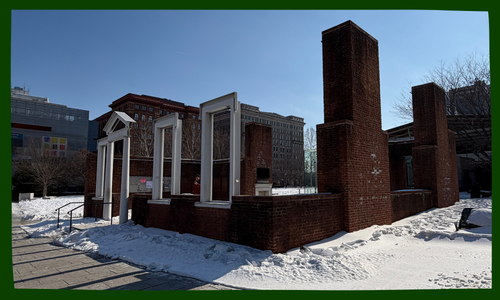
This exhibit, located at Independence National Historical Park, was removed by executive order in January 2026. I visited shortly after. Everything around it had been shoveled after a big snowstorm. The President’s House had not. And yet people were still there — standing in the snow, reading the removed signs aloud, refusing to let the story disappear.
A note from Missy: I started the Our Story series because I believe our parks hold our collective history — the good, the bad, and the ugly. Removing a placard doesn’t mean it didn’t happen. John’s scholarship and his willingness to sit with the complexity of Washington’s legacy — the enslaver and the emancipator, often in the same breath — is exactly the kind of conversation I want this series to be. I hope it makes you curious. I hope it makes you feel something. That’s the whole point.
Episode Guest
John Garrison Marks – Historian & Author
Key Facts
- The President’s House: executive mansion where George Washington lived and worked as president in Philadelphia, 1790s
- 9 humans enslaved by Washington lived and worked in this house
- Named enslaved people: Hercules Posey (chef — escaped to freedom), Ona Judge (escaped to freedom)
- Pennsylvania’s 1780 Gradual Abolition Act: any enslaved person residing in PA for 6 months could claim freedom
- Washington secretly rotated enslaved people out of state (back to Virginia, across to New Jersey) before the 6-month mark — actively undermining the law
- While doing this, Washington was privately writing in support of gradual abolition laws — the defining tension of his legacy
- When Hercules escaped, Washington wrote that he would have to break his vow never to purchase another enslaved person — because he couldn’t imagine hiring a free paid chef
- The house was demolished in 1935 — rediscovered during construction in the late 1990s. The exhibit was created in the 2000s using the rediscovered foundations
- The exhibit used glass walls and visible foundations to tell the story of the enslaved people who outnumbered free people in that residence
- January 2026: Executive order mandated removal of all signage documenting slavery history in National Parks. Everything removed. Placard holders and glue marks remain.
- Community response: handwritten signs placed by community members; people reading removed signs aloud on Saturdays; Missy visited and found snow everywhere shoveled EXCEPT at The President’s House
- The exhibit was at Independence National Historical Park, Philadelphia
- George Washington freed 123 people he enslaved in his last will and testament — but not those legally owned by Martha Washington’s first husband’s estate
Show Notes & Links
- John Garrison Marks website
- John’s Books
- Thy Will Be Done: George Washington’s Legacy of Slavery and the Fight for American Memory – Out April 2026 – Pre-order here
- Black Freedom in the Age of Slavery: Race, Status, and Identity in the Urban Americas
- Race and Nation in the Age of Emancipations: An Atlantic World Anthology
- The President’s House – NPS Site
Episode Transcript
Our Story: The President’s House
The Parks Podcast, Episode 63 | John Garrison Marks, Historian & Author
The landscapes of our nation hold the echoes of every footprint ever laid upon them, weaving together the diverse lives and pivotal moments that shaped our common ground. From the visionaries who protected these spaces to the cultures that have always called them home, our parks are a living tapestry of who we were and who we are becoming. This is Our Story.
Missy Rentz: I am so excited to welcome John Garrison Marks to The Parks Podcast. John is the author of “Black Freedom in the Age of Slavery: Race, Status, and Identity in the Urban Americas.” His second book, “Thy Will Be Done: George Washington’s Legacy of Slavery and the Fight for American Memory,” will be out in April 2026, and he’s currently the VP of Research and Engagement at the American Association for State and Local History. John, welcome to The Parks Podcast.
John Garrison Marks: Thank you so much for having me.
Missy: You are kicking off this series on “Our Story” where we take a deep dive into a person, place, or event that led to the creation of parks. And today we’re talking about The President’s House. It’s an exhibit in Independence National Historical Park in Philadelphia. What is the President’s House and why is this so important to our park system?
John: The President’s House site was the executive mansion when the capital of the nation was in Philadelphia. This is where George Washington lived in the 1790s when he was serving as the country’s first president. This is where he did a great deal of important work in carrying out the presidency and really establishing the traditions and expectations of what the President of the United States would do and would be.
John: And while he was there living in Philadelphia, he exploited the labor of enslaved people. George Washington enslaved other human beings for the entirety of his adult life. He enslaved hundreds of people at his Virginia plantation, Mount Vernon, and he fully expected to have the labor of enslaved people serving him while he was President in Philadelphia. The President’s House is not only where he lived and carried out so much of the early work of the presidency — it is also where the people he enslaved in Philadelphia lived and worked. And began building lives for themselves away from Virginia and in Philadelphia.
Pennsylvania’s Gradual Abolition Law — and Washington’s Secret Scheme
Missy: Was it legal for him to enslave people in Pennsylvania?
John: That is a complicated question. In 1780, before Washington became president, the state of Pennsylvania passed a law to gradually abolish the institution of slavery — the first of these laws. And Pennsylvania’s law, among its other provisions, stated that any enslaved person who resided in Pennsylvania for six months would be entitled to claim their freedom.
John: When George Washington became president and moved to Philadelphia and brought these enslaved people with him, he learned that this law would apply even to him as President. And so Washington, privately and very much secretly, developed a scheme to rotate the people he enslaved out of Philadelphia before they arrived at that six-month mark. He intentionally made sure that they left the state — either went back to Virginia, went across the river to New Jersey, went somewhere else — before they reached that six-month point and could legally claim their freedom. He actively undermined the ability of the people he enslaved to claim freedom.
John: What is ironic and really tragic about this is that at the very same time that Washington is doing this, he is writing privately to associates and friends indicating his support for gradual abolition laws. He hopes that they will spread throughout the United States. He hopes the Virginia legislature will see that this is an important thing for them to do. He is writing in opposition to the institution of slavery, always privately, never in his public role as president. But part of the reason that he is so familiar with how these laws work is because he is working so hard to ensure that the people he personally enslaves can never take advantage of them. And this is the complexity and ambiguity of George Washington’s legacy with slavery that we see throughout his life, and especially in the decades after the American Revolution.
Hercules Posey, Ona Judge, and the Failure of Moral Imagination
Missy: It’s so interesting to me because they’re there in Philadelphia writing “we, the people.” And yet he had these nine humans enslaved just a block and a half away from Independence Hall.
John: Yeah. I think what’s so interesting about the late 18th century is the extent to which the founding fathers recognized the inconsistency between their words and their actions and talked about how it was troubling to them. This was something that was part of the conversation at the time — it was in 1775 that the British essayist Samuel Johnson famously asked, “how is it we hear the loudest yelps for liberty from the drivers of Negroes?” Washington really understood that this was a kind of hypocritical stance to take.
John: He also just seems to have this real lack of imagination when it comes to what another labor arrangement might look like. He writes in the years after the revolution that he intends to never acquire another slave by purchase. While he is in Philadelphia, one of the people who escapes from enslavement at the President’s House is Hercules Posey — Washington’s chef, renowned for his culinary skill. Washington recognized Hercules’s abilities, but he was suffering under the yoke of slavery. He escaped. And after this happens, Washington writes to a colleague saying how disappointed he is that he would now have to buy another enslaved person, because “this vow I fear I now must break.” Because he needed a chef — and it seems like he never imagined the possibility that he would hire and pay a free chef. As soon as the chef that he enslaved ran away, he immediately said, now I need to buy another enslaved person so I can have a chef. At the same time, he is speaking out privately against slavery.
John: His views don’t align in a coherent way. But I think it’s important to remember that people like Washington and Jefferson are not describing human bondage as a positive good the way pro-slavery Southerners would two or three decades later. They recognize that this is not good. They recognize the evils of the slave system, the ways that it is corrosive to American society, but they also just can’t imagine a different arrangement.
Why Slavery Was Avoided in the Constitution
Missy: Was there any contention in the Continental Congress because of all the pro- and anti-slavery factions coming together while they were there?
John: Certainly the slavery issue is a live wire from the very beginning in the United States, and you see all of these places where there is some thought or consideration to talking about slavery directly — and then they always back off. Whether in the drafting of the Declaration or in the framing of the Constitution. In Thomas Jefferson’s first draft of the Declaration of Independence, one of the complaints he is levying against the Crown is their use of the African slave trade — and this ultimately gets struck from the declaration.
John: And then in the debate about the US Constitution, slavery famously does not get mentioned by name. There are many compromises that historians now see as seeding authority to Southern delegates and really delaying any action on the future of slavery in the United States. The most explicit example: the Constitution says the United States government will not create any laws ending the international slave trade for at least 20 years — until 1808. There is just this desire throughout the founding and the framing of the Constitution to try to avoid the issue of slavery. There is a recognition among all parties involved of the ability of slavery to tear apart this really fragile union.
Why Washington Remains on His Pedestal
Missy: I grew up in Virginia, and I remember when there was really the push to start talking about Thomas Jefferson and George Washington having enslaved people. Why is there this hesitancy to take him off this pedestal and admit that he owned and enslaved humans?
John: That’s a great question, and it’s one that I get into a lot in my forthcoming book. Unlike any other historical figure — more than any other person in American history — Washington functions as a symbol of the nation itself. And so anything that someone perceives as being critical of Washington or as diminishing Washington’s stature is viewed as a criticism of the nation. And therefore as a criticism of them, by many people.
John: More than any other historical figure I’ve found, Washington just remains cast in bronze and marble and people do not want to engage with a real and historical version of him. He functions as this endlessly flexible avatar for the nation, and it makes it really difficult to have a conversation about him as a human being. I’ve heard even in present time, in 2025, of there being controversy at a museum for just wanting to say George Washington was a flawed human — which is to say, was human. And so the conversation is often over before it even begins.
The Exhibit Itself — and Why It Was So Powerful
Missy: I think there’s a question of how can you heal when you’re not willing to acknowledge both the man’s successes and this horrible thing that he also did. And I think that’s one thing I really liked about The President’s House — by title, you think it will be this grand history of him, much like Mount Vernon. But it was an exhibit about the nine enslaved people that worked for him.
John: Yeah. And it really was an incredible exhibit. There are many places where you can go and get the story of Washington the general, Washington the president, Washington the leader. You can get that in lots of places in Philadelphia. What I found so powerful about The President’s House site is that it really made very clear and explicit that Washington was actively enslaving other human beings while he was serving as president in this place. That this was the home where he lived — but enslaved people far outnumbered free people in this residence.
John: And it uses that space to tell those stories — to tell the stories of the majority of the people who lived in that house and their experiences in Philadelphia. Their experiences with slavery and with freedom at the time. Philadelphia is home to the largest free Black population in the country. And they are exposed to that world for the first time — they have autonomy by nature of living in Philadelphia that they didn’t have living in rural Virginia. And they are able to see the possibility of Black freedom close up in a way that they never had before. For people like Hercules Posey and Ona Judge, this leads them to escape from slavery and from Washington’s control.
The House’s Destruction and Rediscovery
Missy: That house was torn down in 1935, and it wasn’t rebuilt. It was an interesting exhibit — I’ll show pictures on the website — they used the walls and some glass to show the foundations and tell the story. But it wasn’t until the 2000s that they decided to preserve it and finally tell this story.
John: Yeah. It’s really interesting the way it came about. The house is destroyed in the mid-1930s, but just a few years before that is the George Washington Bicentennial — in 1932, the nation is really celebrating George Washington in all of these ways. That’s when the highway between DC and Mount Vernon is built. That’s when the George Washington Bridge is named. That’s when Washington gets put on the quarter. They create thousands of busts of Washington and send them to state houses and county courthouses all over the country. It’s this huge celebration of Washington in 1932 that the story of slavery is not really a part of.
John: And then it’s just a couple years later that his house is torn down and more or less forgotten about for more than half a century. It’s not until the late 1990s, when there is construction happening at Independence National Historical Park, that they rediscover the foundations of the President’s House and rediscover this history. And there was a real movement among scholars and educators and community members and activists to ensure that this site was redeveloped and was used to tell the story of slavery. That moment in the late nineties, early 2000s becomes really important to seize this opportunity to share this new knowledge and scholarship with a much wider public.
The Erasure — and the Response
Missy: In January 2026, President Trump signed an executive order that he wanted to remove all exhibits that commemorated the history of slavery in our national parks. And on a cold day in January, all of it was removed. It’s a shell — there’s still placard holders, but all the signs are removed. You just see the glue from them. And it’s yet again, trying to remove this history and pretend like it didn’t happen.
John: Yeah. It was really jarring for me to see the videos of Park Service staff just wrenching these signs off the walls. And especially — I’ve spent the last five or six years devoting considerable intellectual work to understanding how Americans have thought and fought about Washington’s history with slavery. And to see it happening in real time was really strange, but also on some level unsurprising. Americans have been fighting over how to understand and how to talk about slavery’s place in George Washington’s legacy since Washington was still alive. There has never been a moment in our history that Americans have all agreed on how to do this.
John: Part of the reason we’ve never agreed on how this story should be told is because there just isn’t one single answer of how to understand Washington’s relationship with slavery. He spoke out against it in private letters. He freed 123 people that he enslaved in his last will and testament. It wasn’t all of the people at Mount Vernon — because more than half of them were legally owned by the estate of Martha Washington’s first husband. But all of the people that George Washington owned outright, he set free in his last will and testament, and that is part of this story too. And that dichotomy — Washington as the enslaver of more people than any of his fellow founders, and also as the architect of one of the largest private emancipations before the Civil War — is one that has allowed Americans for generations to cherry-pick from his history.
Missy: And I was there last week and it was interesting — it was right after this big snowstorm. Everything else was shoveled. This house was not shoveled. And yet it didn’t stop a lot of us from being in the space, in the snow. And what gave me hope was that it sparked great conversation. A lot of people have taken pictures and put them up as protests. I have seen videos of people reading the signs that were there on a Saturday, so that people can still experience the history. And it’s just very hopeful to me that a big majority of this country is saying it is not okay that you remove our history.
John: Yeah. And that’s part of the historical context here too — there have always been Americans who want to erase this history. But it is also true that there have always been Americans who insist that we face this history head on, who lifted it up and insisted that we reckon with it. The actions of community members in Philadelphia now — putting up handwritten signs, insisting that people confront this history, reading the removed signs aloud on Saturdays — has been inspiring. And it has all of these echoes in the American past.
Speed Round
First park memory?
The Grand Canyon. I’m sure I went to others before then, but this was probably when I was 12 or 13 — went out west with my family and saw the Grand Canyon.
What made you love the parks?
I just love that they are this public investment in sharing America back with the American people.
Favorite thing about The President’s House?
I love how difficult it is. I love what it asks of visitors. I love that it demands that we see history for its true complexity.
Important lessons we can all take away from The President’s House?
Sometimes the past only has so many answers for us in the present. There is never going to be some piece of evidence that finally and totally settles this question of how to understand Washington and slavery. That work has always been controversial. It still is controversial. But the work of reckoning can only be done by us here in the present.
What else is piquing your curiosity these days?
It’s the 250th anniversary. I’ve been working on this anniversary and helping museums prepare since 2017. The kind of brewing conflict between how the White House and the Congressional Commission are approaching this anniversary, and how states and communities and community members are thinking about what it means to approach our history and tell our story at 250 years — is something that I’m really looking forward to watching and participating in over the next couple of months.
Greatest gift the parks give to us?
The opportunity to encounter our story in all of these different dimensions. The way that it can hold up a mirror to the nation and have us better understand not only our past, but hopefully better understand ourselves.
Missy: John’s second book, “Thy Will Be Done: George Washington’s Legacy of Slavery and the Fight for American Memory,” is currently available for pre-order and will be out in April 2026. John, thank you so much for sharing the story of The President’s House with us — your knowledge and your experience — and just opening up Our Story to us in a different way.
John: Yeah. Thank you so much for having me.
Missy: That’s it for today’s episode. Until next time — we’ll see you in the parks.
Music for The Parks Podcast is performed and produced by Porter Hardy. Follow us @TheParksPodcast or visit TheParksPodcast.com.