
GirlTREK is the largest health movement for Black women in the United States. It was founded on the insight that Harriet Tubman was the original GirlTREKker — a Black woman who used walking as an act of survival, resistance, and liberation. Morgan Dixon and Vanessa Garrison, co-founders of GirlTREK, join The Parks Podcast to share the story of a movement built around the radical act of walking.
A note from Missy: I love GirlTREK! I learned a lot about the history of the program, and why it’s so important that we all advocate for the health of black women. GirlTREK is making a huge impact. And it also made me realize the important role of groups to help people get outside.
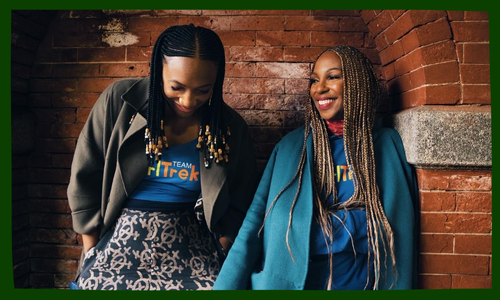
Episode Guest
Morgan Dixon & Vanessa Garrison – Co-founders
GirlTREK
About GirlTREK
GirlTREK is the largest health movement for Black women and girls in America. It uses walking — specifically walking in neighborhoods and parks — as the entry point for community health, healing, and advocacy. Inspired by Harriet Tubman, the organization connects Black women to nature, to each other, and to the history of Black women’s resilience.
Episode Transcript
GirlTrek — Walking Toward Freedom, Health, and Parks
The Parks Podcast, Episode 50 | Morgan Dixon & Vanessa Garrison, Co-Founders, GirlTrek
What Is GirlTrek?
Missy Rentz: I am joined by Morgan Dixon and Vanessa Garrison. They are the co-founders of GirlTrek. Morgan and Vanessa, welcome to The Parks Podcast.
Morgan Dixon: Thank you for having me.
Missy: I am so excited to chat with both of you about GirlTrek. I’m going to start with some stats and research I did, and then we’ll get into who you are. GirlTrek was started by the two of you in 2010. It currently has 1,371,776 members — that is 7% of the population of African American women. The mission is to unleash a mass movement for health justice, with a goal of extending the life expectancy of Black women by 10 years in 10 years. Some of the benefits of the program: 61% of Black women who are members lost weight. 90% experienced fewer symptoms of depression. 28% were prescribed less medication that year than previous years. 59% walked daily at life-saving levels — which according to the CDC is five days per week for 30 minutes. And 56% have sustained a habit of daily walking for more than a year. I’ve talked to you all several times in the past six months, and I feel like I leave every conversation with chills, with some tears in my eyes, and just great motivation for the work that you’re doing. Tell me about GirlTrek. What is GirlTrek?
Morgan: GirlTrek is, I think first and foremost, a community of women who are trying to practice self-care out loud and who are holding one another accountable to doing the same thing. And that community just scaled — it scaled from two friends who were trying to do that and break every single statistic in our own families, every single mindset that had made us want to work harder and faster. We tried to do that in a joyful way and we inspired other people to join us. And so now a million women later, we have a big, bold community of women who are doing that out loud. That’s what GirlTrek is to me. Vanessa, how would you describe it?
Vanessa Garrison: I was thinking about Harriet Tubman. We often say that we are the Harriets of our communities. And so I think about GirlTrek as a million women who are walking their way to freedom and health and bringing their friends and their families along with them.
Self-Care as Political Warfare — and the Joy and Justice Agenda
Missy: I was scouring your Instagram and there was this wonderful video about self-care and about how self-care started as more of a necessity during the civil rights movement. And it has become so commercialized. I thought you all are peeling that onion away and going back to the core and reminding people of the necessities of self-care.
Morgan: That’s a good point that we’ve been working to create a new narrative and a new concept of what it means to take care in a world where we are worth our labor. And that work didn’t begin with us. It started generations ago with people like Audre Lorde who said self-care is not indulgent — it is an act of political warfare. And she understood what it meant to be someone who was expected to be a laborer, and someone who decided to take rest at all costs. So we’re following in that tradition, and we’ve spoken to all sorts of powerful women from that generation who continue to inspire us. I don’t think that we’ve started this movement, but we certainly have continued to be pioneers in self-care.
Missy: You have this joy and justice agenda, which is incredibly inspiring. Vanessa, maybe if you could share a little bit about the different components and facets that are part of the core message.
Vanessa: Yeah. The original message — which is still fundamentally a core part of who we are — was to not ask permission to save our own lives, to start walking in the direction of life. We were a behavior change organization focused on getting women to take their first steps off the couch and start walking. And over 10 years we’ve galvanized over a million women who are doing that. And those women have started to lead in their communities. And those women have also started to tell us that you can’t out-walk the systems that are killing us. We have a collective power in our constituency now, and there is an opportunity for us to organize around things that would not only increase our life expectancy but improve our quality of life. And so the agenda is an outcome of being in community with the women who we’ve been working with and walking with. It addresses the 10 most essential pain points for women and the 10 opportunities for us to create the families and the neighborhoods that we deserve.
Missy: Maybe we can talk about some of those 10 points?
Vanessa: The first one is we want healthy bodies because we want to live and we want our temples to be cared for — that’s where the walking comes in. Then we want healthy minds because there is a mental health crisis in this world and it is really hard to stay in the light. We want healthy families because we need that unit — and that unit was systematically destroyed in an intentional way in this country. We want land and power and economic freedom. We want to care for our caregivers. And we want the next generation to lead. I think it is a new lens by which we are asking for things that freedom fighters have always been asking for.
The Mission — Extending Life Expectancy by 10 Years
Missy: The whole mission of increasing the life expectancy by 10 years in 10 years — I think that was a little bit shocking to me that there was such a discrepancy in the life expectancy of Black women. What inspired you to start the organization?
Morgan: I think it’s 46 years of inspiration — every day I feel inspired to start the organization. It’s a hard question. For me, I think about my Aunt Joyce at home washing dishes. I think about my Aunt Melva rolling down hills when I was a kid. I think about being the first one to go to college in my family and how proud and how big a responsibility that felt like. And then specifically the organization — I come from a humble beginning. I started studying business in college, worked for an investment banking firm, and that’s where I met Vanessa. And then I immediately knew that making wealth was not my calling, so I joined Teach for America and I started teaching. I was an American history teacher, and I was so sad to be talking about manifest destiny and the American Revolution when I saw calorie deficit in the eyes of my kids, and deep exhaustion, and just the effects of environmental pollution, sound pollution. I was teaching in Newark, New Jersey, and it felt like — we just need to go outside for a little bit. We just need to take a walk. And my friend Diana and I started taking our girls hiking. It’s why we’re called GirlTrek actually — it was a club to take the girls outside and to get them walking.
Morgan: There was a girl named India and her mom one time came into my office and was like, what have you been telling my daughter? She’s trying to make me get new stuff at the grocery store. And I said, you’re right ma’am, I’m sorry — you should come on the walks with us. Throughout all of this I was having conversations with Vanessa, who’s been my friend for over 20 years, about this. And Vanessa was working at CNN and she used her employee match donation to support this new idea called GirlTrek. Several conversations and several years later, we were applying for grants to try to get a million of India’s moms walking. I remember I read a statistic that half of Black girls would get diabetes if diet and levels of activity remained constant. And I just couldn’t fathom that half of the girls in my class would get diabetes. Nothing that I taught seemed as important as solving for that.
Missy: Yeah. That’s beautiful. And Vanessa, what inspired you?
Vanessa: There was a lot of personal inspiration for me around having experienced a lot of early death — up close and personal — with the women in my life, and really understanding what that loss meant. What was left behind. How we had to pull it together as a family. And I wanted more years for my grandmother who passed away and for my aunties — I wanted more life for them because they were laboring physically and emotionally and mentally. And I believed Morgan when she said that statistic that half of Black girls may get diabetes. I was living it and experiencing it. And I knew, even for myself as a little girl, that walking saved my life. That getting out of the house — when it was very chaotic, taking a walk in my Seattle neighborhood and looking at the houses and dreaming of what was happening in there and imagining that could be me — like walking had always been my savior. I grew up in a neighborhood where I walked to school by myself from kindergarten through high school. And so I was inspired by the possibilities of what it would mean if we could all be outside walking.
How GirlTrek Gets Women Off the Couch
Missy: We connected because I have this passion and desire to introduce people to the outdoors and being in parks for mental, physical, and emotional wellbeing. And somebody said, you need to talk to them. For so many people, trying something new is the hardest part — just that first step. What is that tipping point that gets people to consider a new program and overcome whatever obstacles prevent them?
Morgan: Yeah, I think it’s a really good question. Early on we had a slogan — we had shirts that said “less talk, more walk.” And it’s this notion of showing, not telling. Do you know Fannie Lou Hamer?
Missy: No.
Morgan: I’m so excited to talk about her. Fannie Lou Hamer was out of Mississippi and she was one of the civil rights leaders — she was responsible for getting like 60,000 people registered to vote in Mississippi, and she became just a showstopper in the Civil Rights Movement. When she gave a recount of her activism at the Democratic Convention, she had been arrested registering people to vote and had been beaten in a jail cell. And when she spoke, she had such tremoring authenticity in her voice that she commanded the attention of the world. We’ve tried to unearth these everyday women who’ve done extraordinary things so that we can inspire women to do something extraordinary — which on some days all of us can account to as getting off the couch. It feels extraordinary.
Morgan: We were honoring Fannie Lou Hamer on what would have been her 100th birthday. We gathered a small group in her hometown, this tiny little town in Sunflower County. We wanted to lay Aretha flowers at her grave site. We paid the local uncle to come and cut the grass because we don’t do a great job honoring our heroes in America. And as we were walking through the street, a woman saw us from her window. She leaned over to her mother and said, “Oh my God, my tribe is here.” She recognized our — what we call — superhero blue shirts. We wear them; that’s how you recognize a GirlTrekker on the street. She had been walking with GirlTrek in solidarity in Fannie Lou Hamer’s tiny little Mississippi hometown by herself for years. She didn’t know we were coming. And she saw a sea of blue shirts. She went and grabbed her shirt from her bottom drawer, ran out — I remember she had on these reddish-orange pants — and joined us and was telling us her story as we’re walking to Fannie Lou Hamer’s grave.
Morgan: I say that because that woman is how we’re getting people off the couch. If they see her enough times in her neighborhood wearing this uniform and walking and transforming her own life, she eventually will have two. And we say “two as a crew” in GirlTrek. Our core mission is to inspire as many crews as we can. Where two or three are gathered — as my mom says from scripture — is really where love lives. If we can have these micro communities, these support networks, the civic infrastructure of groups of women who walk in their neighborhoods — not only do the neighborhoods get safer, not only do the women feel like they belong, but they are also adding up to seven years of life expectancy to their lives. And so that is our change theory.
Missy: I experienced GirlTrek unbeknownst to me until we met. I was in Lake Mead in Nevada on a hike, and I hurt — every part of my body hurt, my skin hurt on this hike. And I came across the blue shirts. And this woman in the group saw me and just sort of put her arm around me and started talking to me. And in a way that I was like, oh my God, I can do this. There was something about being on the periphery of the group just for the hike up the hill that motivated me. And I have honestly never felt something like that out on a trail.
Morgan: Yeah, that peripheral effect is significant. It’s not just the women who are walking with us, but it’s what’s happening with their families and their children and their communities when they’re out. And we have so many people who’ve had experiences like yours. Some of them have been the proximate, real — somebody really put their arm around me. Some of it has been, I heard the laughter coming down the street. Some of it has been, I read the story. But it’s like that proximity to what has happened has been almost as powerful as the direct kind of recruitment and connection. And I think for me, that’s what, when I think about what a movement is — it’s like fundamentally what makes GirlTrek a movement.
GirlTrek and Parks — A Deep Partnership
Missy: And you mentioned the light earlier, and that resonates with me. GirlTrek loves the parks. You all have worked with the parks and you host walks in parks. What role do parks and public lands and nature play in your mission?
Morgan: A big role. I think they’re really essential in so many different ways. First of all, so many of us live disconnected from nature — in urban centers that are noise polluted and hot. And we don’t have enough opportunity to connect with ourselves and connect with nature in that way. Introducing women to the parks has always been a big part of our mission. Giving women, especially women who’ve never had an experience in the park, their first experience — and I often when we say parks, we’re talking about national parks, but there’s also state parks and local parks. And it’s really giving women the understanding that they have ownership over those spaces, that they have a right to be in those spaces, and that those spaces are healing. There is real scientific healing that is happening in those places. So yeah, we’ve been partnering with the National Park Service for almost as long as we’ve been around. We’ve held the largest gathering of Black women in a national park multiple years at Estes Park. We’ve held something called a Summer Trek Series where we’ve gone from Yosemite to Shenandoah to Great Smoky Mountains. We’ve trained almost a hundred women — in partnership with the Sierra Club — to be outdoor trip leaders. And then there’s something called the Adventure Squad. And personally, I think both of us have uplifted the parks in our own journeys.
Morgan: I want to speak about an elephant in the room. Why would we try to rally a million African American women? In this world where we’re talking a lot about inclusion, diversity, and equity — why would that be a mission? And you started off this segment talking about some of the outcomes of GirlTrek, how we’ve reversed chronic disease. Black women are dying faster and at higher rates than any other group of people in America from preventable diseases — from stress that leads to chronic disease, that leads to the number one killer, which is heart disease. So most Black women are dying from broken hearts — from actual heart disease — and that comes from chronic, generational stress and labor. And so here we are, one generation later, not only getting back into the outdoors but going to the highest peaks. That’s something we should celebrate as a nation. We don’t ask for permission to save our lives. We’re inspiring one another to take up space and go into the parks and treat them as the sanctuaries that we know they are — because we’ve always been connected to nature.
Vanessa: Yeah. So much of what you said, Morgan, resonated. I think that we have to diversify that community of people so that other people can see themselves, feel safe, feel welcomed — in the ways that GirlTrek radically welcomes people.
How to Get Involved
Missy: It’s so important. How can people get involved in GirlTrek?
Vanessa: The best thing about GirlTrek is that you can get involved by lacing up your sneakers, walking outside of your front door, taking a walk for 30 minutes and experiencing what it feels like. We definitely want to know that you’ve done it. And so we ask every person to be counted and take the actual pledge so that we can know that they’re a part of the community. We ask them to be in solidarity with us and wear superhero blue so that we can spot each other out there in the communities. And then we ask women to organize their own friends and family so that they can come on the journey with them. It’s really simple.
Morgan: Yeah. I would say everyone listening to this — if you feel inspired or have questions, share this podcast and start conversations. Because I think we just have to talk more. If there’s a Black woman who you love and you want to live as long as women of other races in this country, send this to them and let them know that they’re invited. Anyone listening to this is radically welcome to support us both financially and through participation. And then — we have something called the Trek Code, which is like seven rules. One of them is called “single file and smile.” So you see a big group of GirlTrekkers and they collapse into a single file line, they wave and they say, “Hi, neighbor.” There’s something so powerful about greeting one another. So certainly if you see a GirlTrekker in the street, please say hello, and I promise you, you will get the same warm welcome that Missy got.
Missy: So do you have to be a Black woman to participate as a trekker?
Morgan: You have to be a Black woman to help us achieve our mission, which is to increase the life expectancy of Black women by 10 years in 10 years. You definitely don’t have to be a Black woman to support our mission. And so we need all of the support we can.
Missy: You can go to girltrek.org to learn more, or I’ll list it on the episode notes at TheParksPodcast.com. What’s next for GirlTrek?
Morgan: We’re all taking a Sister’s Keeper Pledge. It’s this big kind of recommitment to one another as a community and as women to keep each other well, to encourage each other, to be in solidarity with one another. And I think it’s going to be transformative. So we encourage everyone to join us. Wherever you find your two, you can also find Self-Care School — it’s a 10-week walking classroom so you can learn all the skills you need to take care of yourself.
Missy: And if I’m listening to this and want to join — is a community already near me, or am I starting a new one? What’s the basic step?
Morgan: Love that question. You go onto girltrek.org, you sign up, you take the pledge — that you will walk out of your front door 30 minutes a day, five days a week. That’s the simplest way to describe what GirlTrek is. You don’t have to join a group, but how we help you to do that becomes very robust support systems: our 10-week podcast, Self-Care School; the ability to find groups in your community on Facebook; a mobile app launching later this year that will allow you to find people in proximity to you; our field guide that teaches you how to organize your community, your church, your sorority, your civic group, your neighborhood, your family; different campaigns that we do month over month to keep people inspired; and events across the country. And we send a newsletter right to your inbox after you sign up at girltrek.org that curates the member experience so that you stay inspired.
Speed Round — Morgan Dixon
Earliest park memory?
My earliest park memory is being at the basketball court with my brother Kevin. And recently a GirlTrekker told me that she remembers me as a baby in the park in Wichita, Kansas, with my big brother Kevin — which I think is illegal for him to have me propped up at the park as a baby. One of my most formative memories is being a camp counselor at Sly Park with Girl Scouts.
What made you love the parks?
The sound of swing sets.
Favorite thing about parks?
That it feels like church. It feels like a sanctuary.
Favorite thing to do at a park?
Recently I learned how to fish with a net in the traditional West African way, and I learned how to do it in South Carolina. So I really love fishing and crabbing and shrimping to feed myself at the parks.
Park on your bucket list?
I haven’t been to Acadia. And then internationally, I really want to see the gorillas in Uganda or Rwanda. So those are my two answers.
Three must-haves for a park visit?
First, a car with a sunroof — because parks are huge and I hate when I have to look out of the window to see the top of the mountain. Hiking sandals, because I like to ground and I like my toes to be free, but I like stability — I climbed all the way up a volcano in sandals one time. And any snack that’s peanut butter — I really love having some protein in my backpack so I don’t get weary and hangry.
Favorite campfire activity?
Singing. I’m a Girl Scout — I love to sing. I like to eat apples and bananas. I love to sing all the Girl Scout songs.
Tent, camper, or cabin?
It used to be a tent until I tented in the Serengeti and there was a lion outside my tent. So now it’s definitely a cabin. I’m a cabin kind of girl.
Hiking with or without trekking poles?
Without.
Favorite trail snack?
Electrolytes and peanut butter. I need all the energy. I just did an 11K hike and I felt like the whole thing was uphill. But I have never regretted a hike — boy, in the middle of it you’re like, I’m really pushing myself to the limit. So electrolytes.
Best animal sighting?
Buffalo in Yellowstone National Park. And my cockapoo was trying to protect us from the buffalo, and we were like, this is not a good size matchup here, dear. The buffalo — I never imagined they were that big. We even saw a grizzly that time. But the buffalo were just so majestic and beautiful and spiritual.
Favorite sound in the park?
A babbling brook.
Greatest gift the parks give to us?
Timelessness. The ability to just lose yourself. To take the deepest pause, the deepest inhale, the deepest exhale. To just be lost for a little bit.
Speed Round — Vanessa Garrison
Earliest park memory?
I grew up in Seattle, in the Central District on 24th and Mercer, and at the end of the block is a park that has been there for at least 70 years. It’s the tiniest little neighborhood park with a tire swing — I think it’s called Frazier Park. I spent 80% of my childhood playing in that park, meeting the kids at that park. Every time I go back home now I drive down the street and it’s there, and I’m just like, wow. My mom played at that park when she was little. I played at that park. And the park is still there.
What made you love the parks?
I love a good summit. Once I started really getting into good hikes and being able to hike up to a summit and see a really beautiful view, it really just enthralled me.
Favorite thing about parks?
Something about wearing hiking boots. I like what you wear when you go to the park. There’s something about the equipment and all of the fun stuff that I love.
Favorite thing to do at a park?
I rode my bike through Glacier National Park — and through Banff — and to be able to see so much of it in slow motion, up close and personal, is probably my favorite.
Park on your bucket list?
I haven’t visited Olympic National Park in my home state of Washington. I would love to visit there.
Three must-haves for a park visit?
Definitely snacks — good snacks, like a big meaty sandwich or leftover dinner from the night before. Music — I’m one of those people on the trail who loves having music to listen to. And my GirlTrek shirt — I just don’t like to go anywhere without it.
Favorite campfire activity?
Definitely roasting marshmallows.
Tent, camper, or cabin?
I haven’t done a camper yet, which would be dreamy. So I’m going to say camper so I can call that in.
Hiking with or without trekking poles?
Without.
Favorite trail snack?
I love candy — like a blow pop, lollipop, or some licorice.
Best animal sighting?
Elk. Every time we drive into Estes Park with a group of women, there’s elk around the campus. And there’s something about seeing a woman who’s never seen a wild animal like that outside, watching her see it for the first time and how close they come up.
Favorite sound in the park?
You know how often in the distance you can hear when birds take flight — the leaves rustle and you’re not sure if it’s the wind or it’s the bird? It’s like that kind of distance sound.
Greatest gift the parks give to us?
I feel like they get us up close and personal with God — with the most natural of natural wonders, which in this way take away any doubt that I have that there’s something so much bigger than me in the universe, and that the universe has had its hand on all of the things that I’m looking at.
Missy: Morgan and Vanessa, thank you so much for being part of the episode, for teaching us about GirlTrek, for inspiring me and educating me on so many things in life. And for your GirlTrekker — for wrapping their arms around me and letting me know I could do it in a really difficult time.
Vanessa: Thank you so much for having me. I’ve really appreciated you and always your questions, your passion for the parks, your intention to detail in learning about GirlTrek and following along, and your passion for staying connected. So thank you.
Morgan: I agree. Thank you so much, Missy.
Missy: Thank you. That’s it for today’s episode. Until next time — we’ll see you in the parks.
Music for The Parks Podcast is performed and produced by Porter Hardy. Follow us @TheParksPodcast or visit TheParksPodcast.com.