
In the early 1800s, Francis Cabot Lowell toured a British textile mill and was told he could look but not write anything down. He memorized every machine in the building. When he got back to Massachusetts, he recreated the power loom from memory — and then built the first planned industrial city in America around it. That city was Lowell. The young women who came to work its mills — ages 15 to 35, from rural farming families — became some of the first activists in American labor history. Ranger Aubrey Brown, the “musical ranger,” joins The Parks Podcast to share a story that sounds modern because it is.
A note from Missy: Mixing parks and fibers — I’M IN! I had never heard of Lowell, but was in the Boston area and decided to make a stop. What a spectacular surprise to learn about the history of textiles, the strength and determination of the women working in the mills, and how that history still plays a role today.
Episode Guest
Aubrey Brown, Interpretive Park Ranger
Lowell National Historical Park
Park Stats
- Location: Lowell, Massachusetts
- Established: June 5, 1978 (President Jimmy Carter)
- Size: 137 acres (embedded in downtown Lowell)
- Annual visitors: 256,303 (2023)
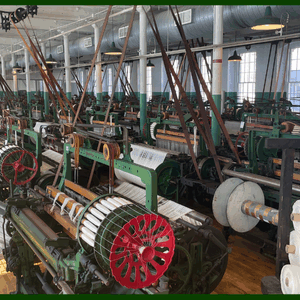
- Key site: Boot Cotton Mills Museum — 90 operating looms (9–15 run at a time), weaving room, boarding house exhibit
- The canals: 5.6 miles of historic canals with walkways; canal boat tours (summer season); trolley rides
- The boarding house: One restored boarding house with recreated 1840s interior — tours available
- Mogan Cultural Center: 1840s Boarding House exhibit + One City Many Cultures exhibit
- Mill specialties (then): Boot Cotton Mills = dish towels/draperies; Suffolk Mill = denim/flannel; Merrimack Mill = cord
- The Voice of Industry: Worker-run journal where mill girls could write anything — religion, slavery, temperance, personal opinion
- The Lowell Offering: Mill-owner-sponsored journal for creative writing
- WWII role: Mills converted to produce canvas for gear, parachute cloth, and durable military clothing
Show Notes & Links
- Plan Your Visit — Lowell National Historical Park
- Boot Cotton Mills Museum
- Canal boat tours — summer season
- 1840s Boarding House exhibit
- Walking tours and trolley rides
- Mogan Cultural Center — One City Many Cultures
- Nearby: Boston (approximately 30 miles)
- University of Massachusetts Lowell — legacy of innovation
Transcript
Lowell National Historical Park — The Mill Girls, the Canals, and the Birth of American Industry
The Parks Podcast, Episode 31 | Aubrey Brown, Interpretive Park Ranger, Lowell National Historical Park
Welcome and Park Stats
Missy Rentz: Today we have Aubrey Brown, who is an interpretive park ranger at Lowell National Historical Park. Aubrey, welcome to The Parks Podcast.
Aubrey Brown: Thank you for having me. It’s a pleasure to be here.
Missy: So we start every episode with some park stats. I’m just going to run through them for Lowell National Historical Park. It is located in Lowell, Massachusetts. The historical park was dedicated on June 5th, 1978 when Jimmy Carter was president of the United States. The park is 137 acres, and in 2023 there were 256,303 visitors through the park. Some interesting facts: it has a textile mill that was built in 1821 at the beginning of the industrial era. The mills were dependent on immigrants and women who were entering the workforce at the time. And the work in the mill was dedicated to war supplies during World War II. The primary products coming out of the mill were cloth typically used for dish cloth, and the boarding houses housed 30 to 40 employees during its heyday. This is a fun park to go to. It was so interesting to me when I toured it. I was so into it — the lifestyle of the people who worked there and the era when it was brought up.
Aubrey: It’s a fascinating park. One thing you find about urban parks like Lowell National Historical Park is the fact that we are so entwined within the community. Even though the park is technically 137 acres encompassing the downtown area, our park is actually very small in terms of what the park actually owns and utilizes. When you visit Lowell National Historical Park, you do get to experience the entire historical downtown. But you also get to have some more intimate conversations when you visit the Boott Cotton Mills Museum or the Mogan Cultural Center, where we have two exhibits in there — the 1840s Boarding House, which explores the life inside and outside of the mills for those early mill girls (they did call themselves mill girls), and also the One City, Many Cultures exhibit, which celebrates the incredibly rich cultural heritage of Lowell — from the very first immigrants, the Irish, to more recent immigrants like the Cambodians, Colombians, and so many other groups.
Missy: And you hit on this, because one of my questions was going to be why Lowell National Historical Park was so important to be part of the National Park System, and you’ve started to mention that and the role it’s played.
Aubrey: It’s an incredible park because when we think about the National Park Service, these units were created to help protect and preserve the natural and cultural wonders of the United States. So a lot of times when people hear the term national parks, we have this vision of what a park is — it’s outdoors, it’s recreational. But we also have cultural places. And here in Lowell we have the opportunity to explore both nature and culture and the built environment, because what we consider Lowell today would not even be here if it was not for the Merrimack River and the natural environment that was perfect for this experiment of building a city entirely dedicated to industry.
The Birth of American Industry — and a Little Industrial Espionage
Missy: So far the parks I have featured on the program have been certainly the natural, but from a historical and cultural perspective, it’s really been presidents’ homes or things that are way back in time. And this is the Industrial Revolution — there are still people living who were alive during it. The mill played an important role during that time. How did it transform that region of the country?
Aubrey: So with the Industrial Revolution, what really happened is after the American Revolution — where we broke away from Europe and created what is now the United States — we were struggling as a young country with that departure because all of a sudden we were having to support ourselves as an individual country. We didn’t have any large-scale industry, we didn’t have a way to really make cloth beyond what could be woven in the home. Cloth is a very important part of the human experience the world over for millions of years. And England had a huge tariff placed, so if we wanted to buy cloth, we had to pay the tariff. So there was this push to find ways to minimize the cost of buying cloth that we needed for everyday life.
Aubrey: And so this idea of stealing the technology — it’s like one of the first industrial espionage things to have happened. England was very secretive about the technology they had for creating textiles, specifically cotton textiles. So you have so many people looking to build a new industry. The name Lowell comes from Francis Cabot Lowell, who was one of the leading founders of what is now the city. He and his friend Paul Moody — an incredible engineer — went over and toured the textile mills. They were told they were welcome to visit, but they couldn’t write anything down or make sketches — they could just walk through. When you pair these two together, you have an incredible duo. Paul Moody was an incredible engineer; Francis Cabot Lowell had a knack for understanding and memorizing every single part of these machines. When they came back to the United States, they recreated this power loom. Moody also introduced the idea of a leather belt as the main drive shaft. They set up the mill in Waltham, Massachusetts, along the Charles River. Another big change was bringing the production all under one roof — previously you would have one mill dedicated to carding alone, another to roving, another to spinning, another to weaving, another to finishing. What Moody and Lowell did was put all that process under one roof. It expedited things tremendously.
Aubrey: But it was still an experiment. They didn’t know if it would work the way they wanted it to. But it did work. And so they started to look around for ways to scale, and they wanted to use water power — because in England they saw smokestack coal being used to power these mills. It was filthy and dirty. They wanted something more utopian, more clean, someplace you want to go to work. And so they found this area that is now Lowell, which was called East Chelmsford. They built more canals, they built more mills, and that’s how the city of Lowell came to be. And the interesting thing — even though it is called Lowell, that is dedicated to Francis Cabot Lowell because he never got to see this dream to fruition. He passed away before he even got to see the first canal dug or the mill operate. He was one of the spearheading members of this team.
Missy: When you talk about mills, I don’t know, it just conjures rundown old kind of concrete buildings. These are beautiful brick — you feel like you’re on a college campus or something when you’re walking in the area. And from what you’re sharing, there was a bit of a breeding of innovation that still lives on today.
Aubrey: Very much. And even though Lowell is not the birthplace of the American Industrial Revolution, what we are celebrating here is the first planned industrial city in the United States that really launched that industrial revolution forward. Every single mill town that came after Lowell based itself on what was happening here. And to this day, in terms of historic revitalization, Lowell is still used as a blueprint.
The Mill Girls — Women, Independence, and the Boarding House System
Missy: Another part of the change that took place in Lowell was the integration of women and immigrants and the role they played in working in the mills. How did that begin to usher in change for the country?
Aubrey: So here in Lowell, the plan from the very beginning was to use women as the main source of labor. They decided to do that for a few different reasons. One — they weren’t sure how it was going to go in the first place, so they didn’t want to pay exorbitant amounts of money to men who demanded a higher cost for their labor. But also, this isn’t too far removed from the American Revolution — only removed by maybe a generation. A lot of the male workforce was already employed, either working as farmers, working in light industry, or their own businesses. They weren’t going to leave what they were doing to come populate these mills. And so when the Boston Associates were putting this whole thing together, they specifically targeted the young working-age women of farming communities. One, they realized — we are weaving. If anyone knows how to create cloth and finish it, guess what? The women are typically the ones doing that in their own homes. So they didn’t have to do as much training — just train them on how to use a power loom versus a manual loom. Another reason: a lot of these farmers, if they had large families and multiple daughters, their daughters weren’t going to be employed very easily outside of the domestic sphere. They were kind of just waiting around doing chores. So this gave them an opportunity to bring them out of the house, give them a way to support their family — a lot of these young girls would send the majority of their income home to their families to help feed them, or maybe send their brothers to university. They were targeting young women typically between the ages of 15 and 35.
Missy: And they can’t have bank accounts and they can’t live alone — but they thought about that.
Aubrey: They did think about that. And so that’s the other unique part of this city. In order to get their parents to allow them to come to the city to work, they set up the boarding house system. I would compare it to a dorm room, where you have a place where you’re living, meals are provided for you. Like a dorm, they had house mothers — the boarding housekeeper and her family. They told the women and their families that when they come to Lowell, we will make sure that they are fed, that they have a roof over their head, that they remain morally responsible — that they’re not going out about the town unchaperoned, that they will be in bed at a certain time. So it was like this unofficial family unit that you have in place. And that really provided an opportunity for large numbers of women to come here and gain a little bit of independence that they would not have had elsewhere.
World War II and the End of an Era
Missy: I want to pivot a little bit because then World War II happens, and the mills played an important part in it. They essentially dedicated themselves to the war.
Aubrey: Very much. The industry here in the city of Lowell was set up for textile manufacturing, specifically for cotton. But then as time went on, there were some deviations into other types of fibers, including silk and nylon — so much effort going to supporting the war. And again, what do your soldiers need? They need clothes. Instead of making towels or drapes or flannel blankets, it was like, okay, we’re gonna start making canvas for their rucksacks, their durable clothing, their hats. We’re also going to make miles and miles of parachute cloth. With World War II, producing fabric of various types for the war effort helped keep Lowell relevant. But it wasn’t going to last — after World War II, you have globalization taking place, and that was really the end.
Missy: And it seems like for the war, they had set themselves up because they had a product that was going to be needed, and they had a labor force that wasn’t dependent on the men going to war. The other piece I want to touch on is that because of the time this was taking place, there was a lot of activism — women’s rights, migrant rights, the rights of enslaved people. And Lowell played a major role in that.
Aubrey: It really did. And I have a walking tour I do called Building Independence, looking at the various institutions that grew up in Lowell to meet the needs of these mill girls and gave them the opportunity to build their own independence. The Lowell Savings Institution allowed them to not only save their money, but slowly build interest on that. Libraries were popping up. And then you have the Lowell Offering — it started out as just this fun little thing for the mill girls to do in the evenings after work. They started to write and share their own stories, true or fictional, write poetry. And they collected it all and distributed it first throughout the city, and eventually people in New York could get a subscription. These are writings by the mill girls for themselves, just to express their creativity. With the Lowell Offering, it was still partially sponsored by the mill owners — so ultimately, if the mill owners didn’t like what you were writing, it’s not going to show up. But on the opposite side you have another journal called The Voice of Industry — where you could say exactly what you wanted to say. It was established by the working class for the working class, and its voice was heard across the country. Any topic was up for discussion, whether it was religion, war, slavery, temperance. One of my favorite quotes I have found in the Voice of Industry — it’s really snarky and I love it — is: “If you invite me out for ice cream, don’t assume that it is because I want your company.” Just that small commentary gives you a sense of how they valued themselves, not just as workers, but as people. And so with all of this, you have the perfect environment for things like activism to grow.
Planning Your Visit
Missy: That really naturally leads us to planning a trip to the park. What do you recommend as the first step when somebody says, I’m coming to Lowell?
Aubrey: When you come to Lowell, I always recommend you start at the visitor center. That’s where you’re going to get directed to anywhere in the park, whether you come with no idea why you’re here or you’re interested in a specific topic. We can tell you where to go, directions on how to walk through the city to meet your needs. For me, the number one thing I recommend for everyone to do — you have to go to the Boott Cotton Mills Museum. We have a room, it’s the weaving room, and we have almost 90 looms that are set up in there and we have them operating.
Missy: It is so…
Aubrey: You get to see these machines running and it is loud. Usually we only run maybe nine to fifteen of the looms at a time — not the full 90, not the full 200 that would have been there — and it’s still very loud. It’s a whole sensory experience. You can feel the vibrations, you hear the noise, you can smell the cotton and the leather and the oil.
Missy: And they’re making dishcloths that you can buy.
Aubrey: Right. And one thing I forgot to mention about the Boston Associates — they’re all friends. You’re not going to compete against your friend. So at the Boott Cotton Mills, they specialized in cloth made for dish towels, for draperies, more utilitarian type of cloth. At the Suffolk Mill, they specialized in denim and flannel. At the Merrimack Mill, they specialized in corduroy. They didn’t want to compete against each other. And also attributing to this idea of activism is the fact that because they didn’t want to compete against each other, every single mill paid their workers the same rate, no matter their skill. So at the Boott Cotton Mills, because it was a more utilitarian type of cloth, we do make replicas of the patterns that were used right here in the Boott Cotton Mills. So you get to see the looms all set up and see reproductions of what was actually coming out of this specific mill.
Missy: And at least when I did the tour there, there was somebody who was running the machine. We were the only people in the room at that moment — he kind of stopped and talked to us and explained everything that was going on. And then you continue on and get to more of that traditional museum where it’s the stories and the pictures and the examples of the clothing and all of that. That was such a great experience — a step back in time. And then the next stop for us on the trip was a boarding house. You actually have one of the boarding houses opened for tours.
Aubrey: There are very few boarding houses that still remain in the city, and we are fortunate that we have one of those boarding houses that we’ve been able to recreate. The exterior, the framework of the building, the foundation, the walls — it was all there, but we had to step back in time and recreate the facade because over time it had just been made unrecognizable by additions. But inside, you walk in, you go down a ramp, and it’s just like you’re in some generic hallway. There’s nothing that screams, ooh, a boarding house — until you go around the corner and you enter the boarding house and you get to see a setup of what it would have been like. What your room would have been like as a young girl coming here — probably full-size beds crammed very close together, just enough room to walk between them. A writing desk. You get to see the kitchen where the boarding housekeeper would have prepared the meals. And it really is a step back in time, understanding a little more intimately what it meant to leave your family to come here and find a new family in a lot of ways. And you would have two girls per bed. To share a bed with a perfect stranger, in close quarters…
Missy: So you have the mill, the visitor center, the boarding house. When you look at the map, it’s a lot of property. What can people do? Is it just a walking and exploring opportunity?
Aubrey: I would say Lowell is definitely more of a walking and exploring opportunity. We are very fortunate to have 5.6 miles of our canals still in existence, and we have walkways along those canals. So you can walk along the canals, see how the water was directed to these old mill buildings, and experience the city very much like the early inhabitants did. Another thing that made Lowell unique is that the Boston Associates — many of whom were amateur horticulturists — wanted every part of it to be an enjoyable experience for the people who came. So you have little strips of parks alongside the canals. You get to walk the waterways, surrounded by these large mill buildings. And the majority of the park is free to enjoy. We offer walking tours. We offer trolley rides where you can get on a replication of a historic trolley and take it from the visitor center to the Boott Cotton Mills Museum.
Missy: It makes it accessible, because it is very spread out. And I think you made the point that it’s really immersed into the city — you almost don’t know what’s the city and what’s part of the park. Do you think there’s a specific time of year you recommend people visit?
Aubrey: During the summer is probably the peak season for us because we have a lot more available to explore and the weather’s nice — it is very much a walking outdoor type of park. But in addition to that, we have our canal boat tours where you get to get on a boat, go up the original Pawtucket Canal, and learn with a ranger what that was like. Every ranger creates their own programs — you’re going to get something different from me than you get from Ranger Claire or Ranger Nadia or Ranger Jacob. You could take the boat ride with every single ranger and still get a different experience. I take a little more in-depth look at the behind-the-scenes of this city — it’s a city, and you have to have so many supporting players in order to maintain it. I’m also known as the musical ranger, so you might get a little song and dance. You have the canal boat tours, which do cost to go on. But if you want to take a tour to the Suffolk Mill where you can see a turbine and really see how the water was transformed into power — because we weren’t generating electricity with the water power, that’s where our brains today go. No — it was pure kinetic energy, just that force of water, that 32-foot drop, that allowed that water to move the wheels, to move the turbines, to move four, five, six floors of machinery to make these mills work. There is a small fee to go into the Boott Cotton Mills Museum as well, to help us maintain our historic looms. We also do have a limited availability to take a boat ride on the Merrimack River — you get to go on the park’s pontoon boat and experience the river with a ranger.
Missy: And Lowell is not far from Boston. It’s a great opportunity and it’s in a city, so from a lodging perspective, there’s not lodging in the park — but you’re in a city, and it’s a great stop if you’re in Boston and looking for something to do. I get excited thinking about it. I always get a Christmas ornament, and for Lowell I got one of the bobbins. Every Christmas I put it on thinking about that experience. It was just so much fun. The cultural history, the time in American history that it took place, the impact — it’s just fascinating to see how some things, history repeats itself. To see what have we learned, what have we not learned about history.
Aubrey: And no matter where you stand on the history platform — whether you enjoy history or you don’t — there’s plenty here that is not just history. It’s engineering, it’s culture, it’s food, it’s everything. There’s nothing you can’t find to satisfy every single person in your party.
Missy: Aubrey, what else are the must-sees when people come to visit the park?
Aubrey: Even though we are predominantly an industrial history park, there are so many other things that build on top of that. The social history of the city is very much defined by all the immigrant communities that came to Lowell because of the mills and the manufacturing opportunity. After the mill girls started their own activism and said, yeah, we’re worth more than what you’re paying us, all of a sudden you have empty spots to fill. So you bring in the Irish community, and then the French Canadians come down to work in the mills, and then you have the Greeks, the Polish, the Colombians, the Cambodians. All of a sudden you have this entire vibrant city with their own little communities, all melding together — and it’s a beautiful thing to see. And that’s all encapsulated in the One City, Many Cultures exhibit also in the Mogan Cultural Center with the Into an 1840s Boarding House exhibit. It takes you on a journey from the earliest days to the present, showing that even though each culture is so different in many ways, the basics of humanity are all the same. You get to explore the clothing, the food ways, traditions that may be different, but all harken back to the same basic human desires.
Speed Round
Earliest park memory?
My earliest park memory is a trip that my family took to Mammoth Cave National Park. I grew up in Ohio and Mammoth Cave was right there. We were not a National Park family — we just didn’t go to national parks — but Mammoth Cave, it’s cool. I very distinctly remember descending down into this cave. I thought we did the entire cave. No, we did maybe a mile of the 400-plus miles of Mammoth Cave. But for me, we did the whole cave.
What made you love the parks?
Honestly, it’s the rangers. The parks do speak for themselves, whether it’s a natural park or historical park. But having the opportunity to talk to a ranger who knows some of those hidden stories, who knows how to help you connect to those places — and it’s not just the interpretive rangers that give you the tours. Even the maintenance workers, they have their own stories and they can share their own experiences with you. These natural and cultural national park units, it doesn’t matter unless you have that human connection. And the park rangers give you that human connection.
Favorite thing about Lowell National Historical Park?
Honestly, my favorite thing is the fact that there is so much here. I’m never bored. I’m constantly finding new things to research, new things to take deep dives into. If I had to give a favorite thing that a visitor can experience, I’m going to say the Suffolk Mill tour — because seeing the power looms operating and everything is great, but the Suffolk Mill tour gets you down deep into the guts of these mills to see exactly how ingenious they were in manufacturing. I’m not an engineer, but I like to know things. That gives me the opportunity to really wrap my head around this whole city.
Park on your bucket list?
I am a social historian. I started out in archaeology before switching over to history, and I am very much interested in social institutions that were created in the 19th century — things like poorhouses, orphanages, hospitals. The park that I just want to visit is Kalaupapa in Hawaii on the island of Molokai. It’s an active community — one of the few national parks that has an active community there. From the 19th century, even up until the 1950s, people were sent to this remote location for leprosy — not really to cure leprosy, just to shove them away because there was no cure at the time. I would love to go to Kalaupapa to see how they first set up the community, but also to learn how the people who were sent there survived, how they passed their days. And even today you have people who were sent there for leprosy or are descendants of families that were sent there. That’s just a part of history that I think we need to appreciate a little more.
Three must-haves for a park visit?
Water, snacks, and very good walking shoes. Whether you’re hiking a mountain or walking downtown, you’ve got to have good footwear.
Favorite campfire activity?
Here at Lowell we don’t really have a campfire activity like you might get at other parks. But for me at other parks, I like to learn more about the nightlife — whether it’s astronomy or animals that are native to the area and how they exist at night. Just having the opportunity to be immersed in a time where normally we’re shuttered in our homes, and being able to be outside experiencing whatever is available.
Tent, camper, or cabin?
I love to be in a tent. I just feel like I am in a cocoon. I’m in nature, but I still have that nice little protective barrier. But there’s nothing like hearing the zipper in the morning when you unzip it and instantly you’re there.
Hiking with or without trekking poles?
It depends on the terrain. If I’m just walking on fairly level surfaces, usually no trekking poles. But I do find that they are very beneficial, especially on varied terrain or steep inclines. They just provide a little extra stability. And I am one of those people — I cannot walk without looking around and I get distracted. So the trekking poles do help me when I need to be paying a little more attention to my footing instead of what’s around me.
Favorite trail snack?
Roasted chickpeas and dried fruit. It’s a good salty-sweet combination.
Best animal sighting?
The standard animal sighting would be — I saw a mountain lion when I worked at Carlsbad Caverns National Park. I was driving out of the park after a night sky program and this mountain lion just casually crossed the road. I had to really second-guess what I saw. But I asked some rangers who had been there longer and they said, oh yeah, was it at mile three? And I said yes. They said, it was a mountain lion — multiple people had seen the mountain lion at mile three. But my favorite wildlife encounter has to be at Carlsbad Caverns watching the bat flight. You have thousands of bats just billowing out of the cave. To be able to be there and just hear it, smell it — it’s an incredible experience.
Favorite sound in the park?
Okay, this is going to be weird — but we have an electrical panel that you click on to open up the boarding house and it goes ping, ping. I like the pings. But my favorite sound that’s not weird and random — I love when those looms turn on. I just love the rhythm. I dance to it every time. So we’ll go with the looms.
Greatest gift the parks give to us?
Wonder. No matter where you are, they’re going to give you wonder and curiosity, and just make you step outside of your own little bubble to realize that there is much more out there, and that there are things that are worth protecting — because they are not limitless. They’re finite resources that could easily disappear, whether it is the natural land or whether it is the mills. At any point in time this could all go away. And so that wonder that you’re left with — it’s what makes it all worthwhile.
Missy: Aubrey, thank you so much for sharing your time and your passion and the experience of Lowell. It’s a pleasure to talk to you today.
Aubrey: It was such a pleasure to talk with you today as well, and I thank you for doing what you do because our national parks, they are for everyone. But now that I am a part of that, I can see just how much I missed by not having that experience. And so I wish that for everyone. These parks are for everybody.
Missy: Thank you. And thanks everybody for listening. Until next time — we’ll see you in the parks.
Music for The Parks Podcast is performed and produced by Porter Hardy. Follow us @TheParksPodcast or visit TheParksPodcast.com.